

You are typing a message, an email, or a caption, and you pause. Is it "to much" or "too much"? Both look right at first glance, they sound identical, and your phone will happily accept either one. Here is the short answer: "too much" is correct, and "to much" is always a mistake. If you mean "more than enough", you need the word with two Os.
The confusion is understandable. "To" and "too" are two of the most common words in English, and they sound exactly the same when you say them out loud. But they do completely different jobs. "Too" is the word that means "more than enough", and "much" needs it, not "to".
Related Post: What Does SMH Mean in Text?
Quick Answer
"Too much" is correct. "To much" is always wrong — there is no sentence in English where "to much" is the right choice.
"Too much" means more than enough, more than is wanted, or more than is needed. "To" is a different word entirely: it shows direction, purpose, or a destination, as in "go to school" or "give it to me". It can never sit in front of "much" to mean "a lot".
- Always write "too much" with two Os — in essays, emails, texts, captions, and exams.
- "To much" is never correct. You will not find it in any dictionary, and a spellchecker will often miss it because "to" and "much" are both real words.
- "Too" means "more than enough". That is the whole test: if you mean "more than enough", use "too".
What Does "Too Much" Mean?

"Too much" is a phrase that means more than enough, more than is wanted, or more than a person, place, or thing can handle. If your coffee is too sweet, there is more sugar in it than you wanted. If a film is too long, it went on past the point where you were still enjoying it.
The word "too" does the heavy lifting here. On its own, "too" means "in excess" — beyond what is enough, good, or wanted. Put it in front of "much", which means "a large amount", and you get a phrase that describes an amount that has gone past the comfortable limit. "Much" by itself is neutral; "too much" adds a judgement: there is a lot, and it is more than I want.
Here is how the meaning shifts depending on the situation:
- Food and drink: "This soup has too much salt." There is more salt in it than tastes good.
- Money: "That jacket costs too much." The price is higher than you think it is worth.
- Time and effort: "He spends too much time on his phone." The time is more than is healthy or sensible.
- Work: "I have too much work this week." The workload is more than you can manage in the time available.
Notice that "too much" always carries a small complaint or warning inside it. Nobody says "too much" about something they are happy with. It is a phrase for excess, and the "too" is what carries that meaning.
Why "To Much" Is Wrong
If "to much" is always wrong, why does it appear so often in texts, comments, and social media posts? The answer is simple: "to" and "too" sound exactly the same, so your ear cannot tell them apart. When you type quickly, your fingers reach for the shorter, more common word — and "to" is one of the most frequently typed words in the entire language.
But the two words do completely different jobs, and swapping them changes the meaning of a sentence. "To" is a preposition. It points somewhere: "go to the shop", "talk to your teacher", "give the book to Sam". It can also show purpose: "I came here to help." It never, ever describes an amount. "Much" needs a word that can describe quantity, and "to" cannot do that job.
A few things keep the mistake alive:
- They are homophones. "To", "too", and "two" are pronounced the same way, so the mistake is invisible when you speak. You can only catch it by reading what you wrote.
- "To" is far more common. You type "to" dozens of times a day, so your fingers default to it. "Too" feels like the extra effort, even though it is the right word.
- Spellcheckers often miss it. "To much" is made of two correctly spelled words, so a basic spellchecker sees nothing wrong. Only a grammar checker, or a careful human reader, will catch it.
None of this makes "to much" correct. It is a mistake in every context — a text, an essay, a work email, or an exam. The good news is that it is one of the easiest mistakes in English to fix, because the rule is absolute: "to much" is never right.
The To, Too and Two Confusion
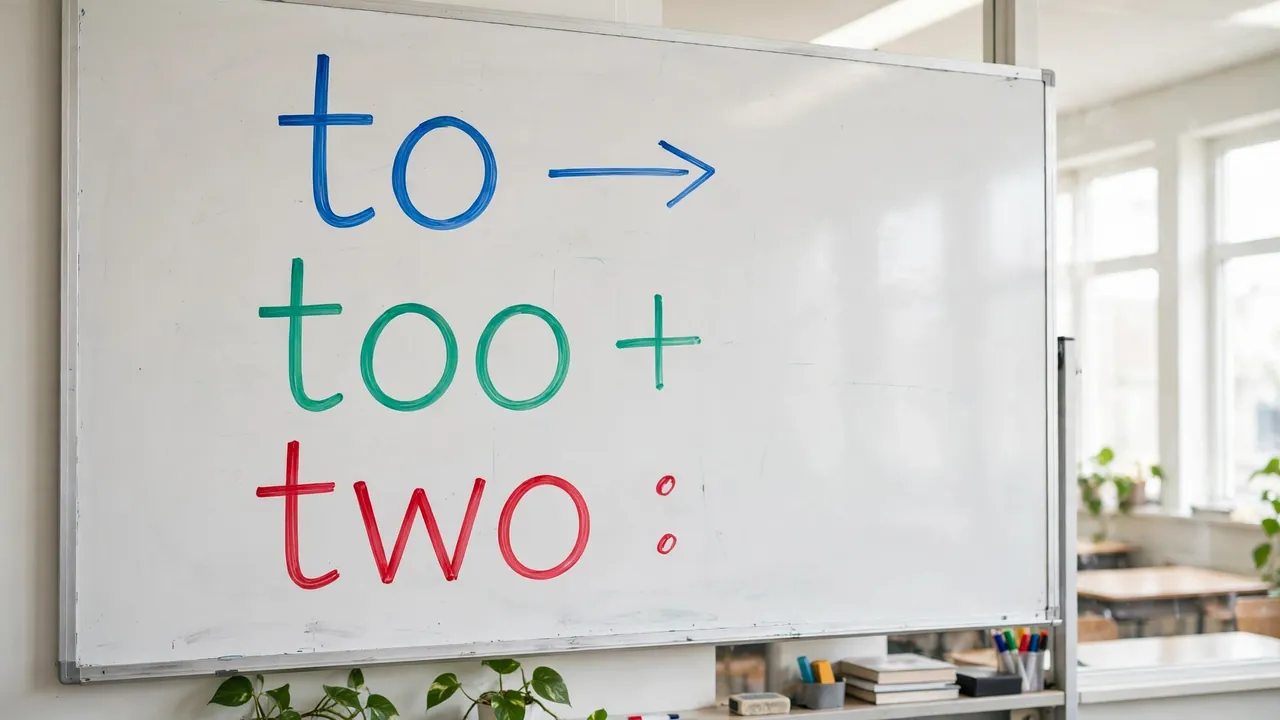
The real reason "to much" survives is that "to", "too", and "two" form one of English's most confusing homophone trios. They sound identical, they are all short, and they all turn up constantly. Once you learn what each one does, though, the confusion disappears.
"To" is a preposition. It shows direction, destination, or purpose. Think of it as an arrow pointing somewhere: "walk to the station", "send it to me", "I went there to see the show".
"Too" is an adverb. It means "more than enough" or "also": "too hot", "too late", "me too". If you could replace the word with "excessively" or "also" and the sentence still works, it is "too". This is the word that belongs in front of "much".
"Two" is a number. It means the number 2, and nothing else: "two chairs", "two weeks", "two of us". If you can swap in "2" and the sentence still makes sense, it is "two".
Here is a quick way to keep all three straight:
- "To" points somewhere. It is the arrow word — to the shop, to school, to bed.
- "Too" means "more" or "also". It has an extra O, and it means something extra — more than enough, or as well.
- "Two" is the number. If you can count it, it is "two".
The extra O in "too" is actually a helpful clue. "Too" means extra — extra hot, extra late, extra much — and it has an extra O to match.
If you enjoy untangling everyday confusion like this, the guide to pricy or pricey settles a spelling question in the same way, one letter at a time.
To Much vs Too Much Compared
The fastest way to settle the question is to see the two phrases side by side. One is standard English, one is never right, and the difference is a single letter.
| Phrase | Correct? | Example |
|---|---|---|
| too much | Yes — the standard phrase | "There is too much sugar in this tea." |
| to much | No — always a mistake | "There is to much sugar in this tea." |
| too many | Yes — for countable things | "There are too many people here." |
| to many | No — always a mistake | "There are to many people here." |
Notice the pattern in the table. "Too" works with "much", "many", "late", "hot", "big" — any word that can be too much of something. "To" never works in that spot.
There is also a useful habit hidden in this table. "Too much" goes with things you cannot count one by one — sugar, noise, time, money. "Too many" goes with things you can count — people, chairs, emails. Both use "too", never "to".
Correct vs Incorrect: Example Pairs
See the right and wrong versions side by side, and say the correct sentence out loud — hearing it helps it stick.
| Correct | Incorrect |
|---|---|
| "There is too much salt in this soup." | "There is to much salt in this soup." |
| "I spent too much money this month." | "I spent to much money this month." |
| "It is too much to ask." | "It is to much to ask." |
| "She talks too much in meetings." | "She talks to much in meetings." |
| "We have too much work and too little time." | "We have to much work and to little time." |
Look closely at the last pair. It contains two mistakes in one sentence, and the second one — "to little" instead of "too little" — is exactly the same error in reverse. "Little" needs "too" just as much as "much" does, because both describe an amount that has gone past a limit.
Notice too that the meaning never changes between the two columns. That is why the mistake survives: "to much" still gets the message across, and nobody in a group chat stops to correct it. But in a job application, a school essay, or a work email, the wrong spelling is a small slip that makes a reader doubt the rest of your writing.
Related Post: Surprise or Suprise: Which Spelling Is Correct?
A Simple Memory Trick
Here is the trick: "too" has an extra O because it means extra. More than enough is extra, so the word that means it carries an extra letter. "To" is the plain, ordinary word — one O, no extras, just pointing you somewhere. "Too" is the generous one, with an O to spare.
Try it as a question every time you hesitate. Ask yourself: "Do I mean 'more than enough'?" If the answer is yes, you need "too" — the word with the extra O. If you mean direction, purpose, or a destination, you need "to" — the short word with one O.
Too Much in Real Life

"Too much" is an everyday phrase that turns up wherever people talk about limits — texts, shopping, work, and complaints about the weather. And just as you would check what FOMO means before using it in a message, it pays to get this phrase right too.
In text messages, "too much" is usually a reaction to something that went past a limit, or a polite way of saying no:
- "That is too much money for a phone case, honestly."
- "Sorry, I ate too much at lunch — I need a walk."
- "You are too much sometimes, you know that?" (Here it means "you are over the top", in a fond, joking way.)
Notice how much work the phrase does in so few words. Each message says two things at once: here is the amount, and here is how I feel about it.
When you are shopping, "too much" is the phrase you reach for when a price, a portion, or a pile crosses the line:
- "This one is too much — the other shop sells the same thing for half the price."
- "I bought too much food again. The fridge is full and I still have two bags left."
At work, "too much" is how people describe a workload that has grown past what one person can handle:
- "I have too much on my plate this week to take on another project."
- "There is too much paperwork for one person — we need help."
"Too much" does not always mean bad. Sometimes it is a compliment in disguise — "too much fun", "too good to be true" — but it always means "more than the usual amount". The phrase is useful precisely because it carries that sense of excess, and the "too" is what puts it there.
Common Mistakes with "Too Much"

Even people who know the rule slip up. Here are the mistakes to watch for.
- Writing "to much" in formal writing. In a text it is harmless, but in an essay, a job application, or a work email it reads as a spelling error. Always use "too much" in formal contexts.
- Writing "to many" instead of "too many". It is the same mistake with a different word. "Too many" is for things you can count, and it needs "too" just as much as "too much" does.
- Writing "to little" instead of "too little". The opposite mistake, and just as common. "Too little" means "not enough", and it still takes "too".
- Using "too much" with a countable noun. Say "too many people", not "too much people". "Much" is for things you cannot count one by one, like water, noise, or time. "Many" is for things you can count.
- Confusing "too" with "very". "Too much" means more than enough; "very much" just means a lot. "I like it very much" is a compliment. "I like it too much" suggests the liking itself has become a problem.
The disc or disk guide settles another one-letter spelling question the same way, if you enjoy catching these small differences.
FAQs
Is "to much" ever correct?
No, never. There is no sentence in standard English where "to much" is the right choice. "To" shows direction or purpose, and "much" needs the adverb "too" to describe an amount.
What is the correct spelling: to much or too much?
"Too much" is correct, with two Os. It means more than enough, more than wanted, or more than needed. "To much" is a common misspelling caused by the fact that "to" and "too" sound exactly the same.
What does "too much" mean?
"Too much" means more than enough of something. It describes an amount that has gone past the point that is wanted, comfortable, or sensible — too much salt, too much noise, too much money, too much work.
What is the difference between "too much" and "too many"?
"Too much" is for things you cannot count one by one: too much water, too much time, too much sugar. "Too many" is for things you can count: too many people, too many emails, too many chairs. Both use "too", never "to".
Can "too much" be a compliment?
Sometimes, in a playful way. "You are too much" can mean "you are hilarious and over the top" when said to a friend, and "too much fun" means a great time. Even then, the phrase still means "more than the usual amount" — the compliment comes from the tone, not from a different meaning.
Conclusion
The answer is simple: "too much" is correct, spelled with two Os, and "to much" is always a mistake. "Too" is the word that means "more than enough", and it is the only word that belongs in front of "much". "To" points somewhere — to the shop, to school, to a friend — and it can never describe an amount.
The mistake is so common because "to" and "too" sound exactly the same, because "to" is one of the most typed words in the language, and because spellcheckers usually let "to much" through without a word. The error only shows when you read what you wrote, which is why it slips past so many people.
So next time that little pause arrives, remember the check: do you mean "more than enough"? If yes, you need the word with the extra O — "too" means extra, and it has an extra letter to prove it.
Related Post: Tear or Tare: What's the Difference?

Emily here. I write about puns, slang, and the quirky side of language because words are funnier than people give them credit for. Four years in, and I still laugh at my own jokes. Someone has to.
