

You are writing an email about your laptop, and your finger hovers over the keyboard. Is it "hard disc" or "hard disk"? You are texting a friend about a slipped disc in your back — or is it a slipped disk? And the album you just bought: a compact disc or a compact disk? Both spellings look right, both sound exactly the same, and spellcheck accepts either one — and guessing wrong makes your writing look careless.
Here is the short answer: disc and disk are two spellings of the same word, and the right one depends on what you are talking about. In British English, disc is the usual spelling for most things — a CD, a DVD, a disc in your spine. In American English, disk takes over for computer storage, so Americans write "hard disk" and "floppy disk" while still writing "compact disc".
Related Post: What Does ACC Mean?
Quick Answer: Disc or Disk?
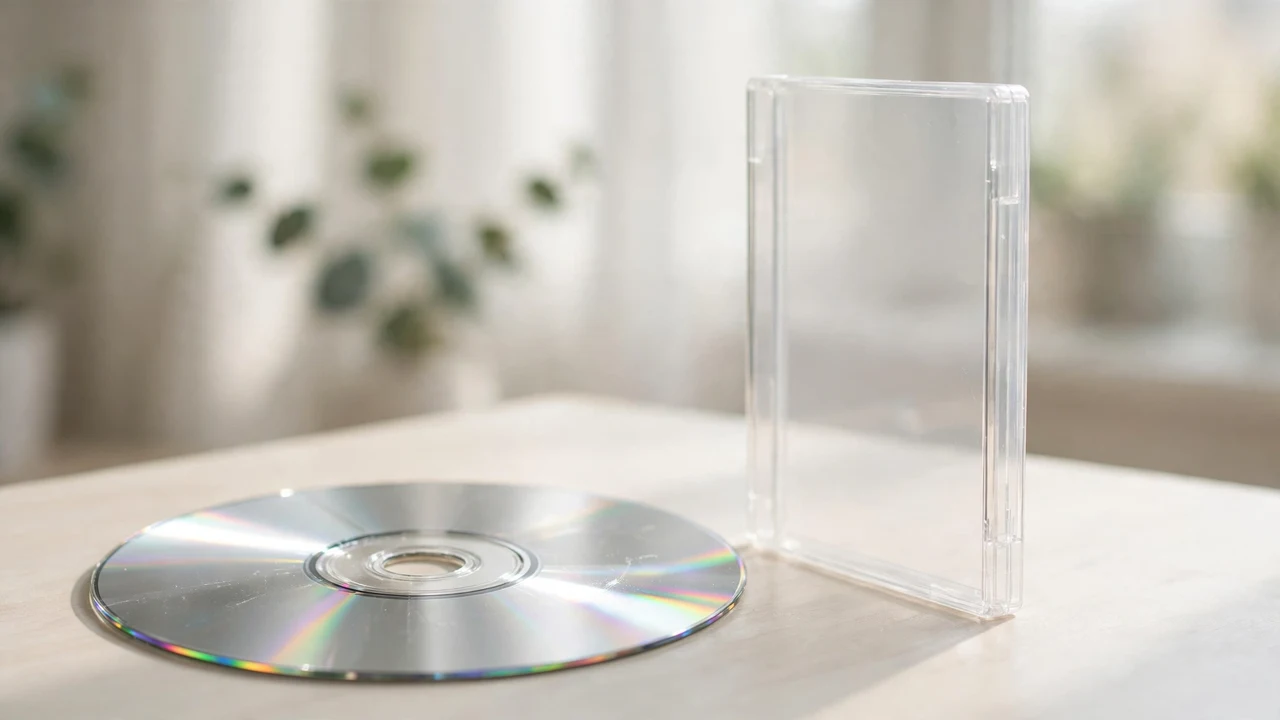
Use "disc" for round, flat objects like CDs, DVDs and the discs in your spine, and use "disk" for computer storage like a hard disk or a floppy disk. In British English, "disc" is the default spelling; in American English, "disk" is the standard spelling for anything computer-related.
- Disc is the older spelling. It comes from the Latin word "discus", and it was the standard spelling in English for centuries.
- Disk arrived with computers. American computer makers in the 1950s chose "disk" for storage devices, and the spelling stuck.
- The two spellings sound identical. There is no pronunciation difference at all — the choice is purely a spelling convention.
- Context decides, not sound. A "compact disc" and a "hard disk" are both round and flat, but the industry that named each one fixed its spelling.
What Does "Disc" Mean?
The word "disc" means a thin, flat, round object — something shaped like a plate or a coin. It comes from the Latin "discus", borrowed from the Greek "diskos", the heavy round object athletes threw in the ancient games. That sporting discus is still called a discus today, and the shape is the whole point: if it is round, flat and fairly thin, English has been calling it a disc for hundreds of years.
You meet "disc" in everyday life more often than you might think. The music and film world runs on it: a compact disc, a DVD disc, a Blu-ray disc. Your body runs on it too: the soft cushions between the bones of your spine are called intervertebral discs, and when one slips out of place, doctors call it a slipped disc.
Here are the most common uses of "disc":
- A compact disc (CD): the shiny silver disc that holds music or computer files, read by a laser.
- A DVD or Blu-ray disc: the same idea as a CD, used for films and high-capacity data.
- A spinal disc: the soft pad between two vertebrae in your back that cushions the bones.
- A disc brake: the round metal plate in a car's braking system that the brake pads grip.
What Does Disk Mean?
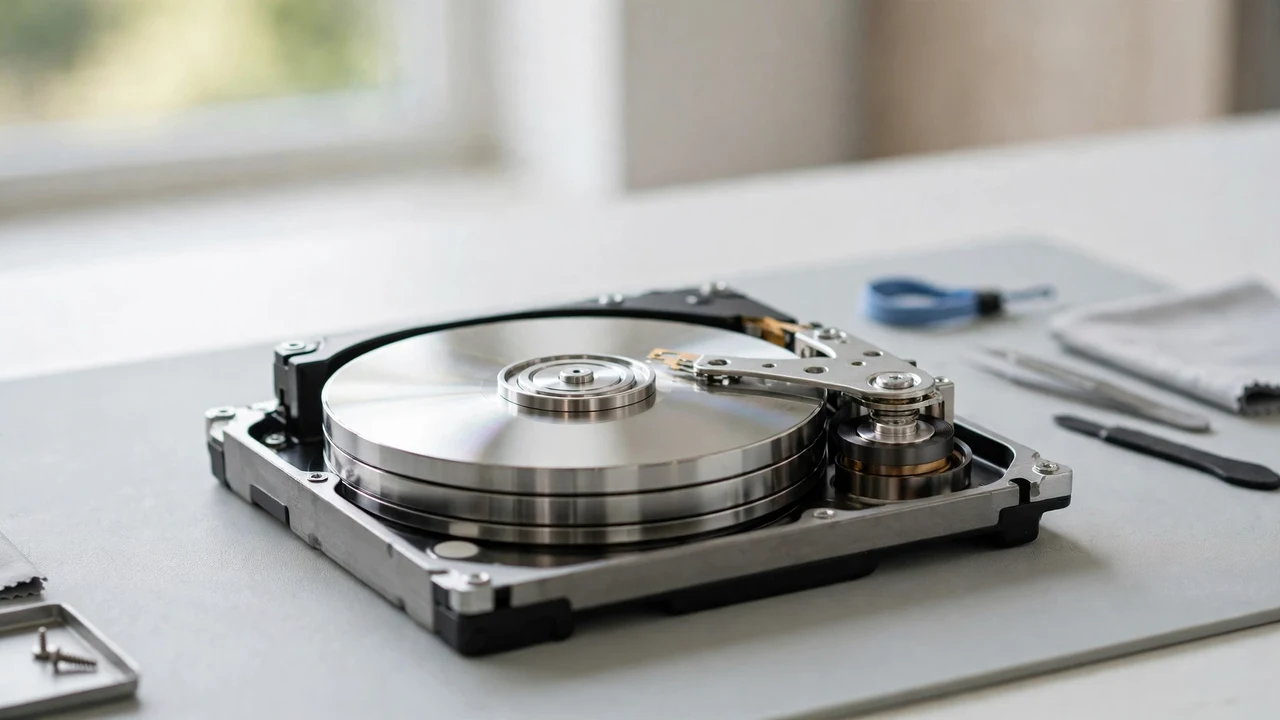
"Disk" means exactly the same thing as "disc": a thin, flat, round object. It is not a different word with a different definition. It is the same word, spelled with a "k" instead of a "c", and it took hold in one particular world: computing. When American computer companies started building storage devices in the 1950s, they needed a spelling for the round magnetic plates inside their machines, and IBM settled on "disk". The spelling spread through the whole industry from there.
That is why the computer terms you know all use "disk": a hard disk, a floppy disk, a disk drive, a disk image, disk space. None of these is spelled with a "c" in standard usage, and writing "hard disc" marks you out instantly as someone who does not spend much time around computers.
Here are the places where "disk" is the correct spelling:
- A hard disk: the main storage device inside a computer, built from spinning magnetic platters.
- A floppy disk: the old square, flexible storage disk that computers used in the 1980s and 1990s.
- Disk space: the amount of free storage on a computer, as in "you are running out of disk space".
- A disk image: a single file holding an exact copy of a whole disk, used for backups and installs.
The Spelling Split: British vs American English
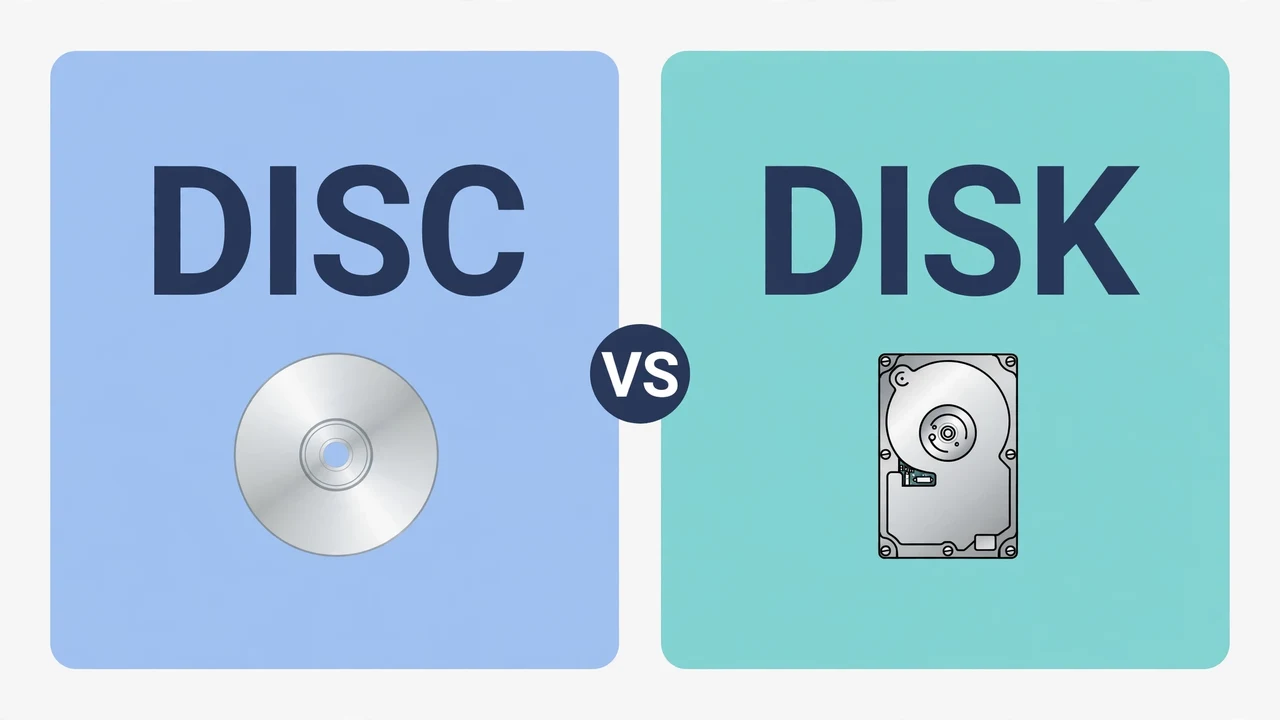
In British English, "disc" is the default spelling for almost everything: a compact disc, a slipped disc, a disc brake, a discus. Computer storage is the one big exception, and even there British usage has wavered — older British manuals sometimes wrote "hard disc". Modern British style guides have mostly accepted "hard disk" for computers, following the American-led tech industry. So a British writer today writes "disc" for a CD and "disk" for a hard drive.
In American English, the split is cleaner. Americans use "disk" for computer storage — hard disk, floppy disk, disk space — and "disc" for most other things, especially music and medicine. An American doctor still writes "slipped disc", and an American music fan still buys a "compact disc".
- British English: "disc" everywhere, except computer storage, where "disk" has become standard.
- American English: "disk" for computers, "disc" for music, film and anatomy.
- International tech writing: "disk" wins for anything about storage, whatever the writer's nationality.
- Music and medicine: "disc" wins on both sides of the Atlantic.
The Exceptions: Compact Disc, Hard Disk, Spinal Disc and Floppy Disk
Most spelling rules have a few rebels, and this one has four famous ones. Each is a fixed phrase: the spelling was decided by the company, the industry or the medical profession that named the thing, and no amount of logic about British versus American English will change it.
Compact disc is always spelled with a "c". The name was fixed in 1982, when Philips and Sony launched the format together, and both companies used "disc" in the official name.
Hard disk is always spelled with a "k". IBM set the spelling in the 1950s, when it built the first hard disk drive, and the whole computing industry followed.
Spinal disc is always spelled with a "c". Doctors and physiotherapists write about intervertebral discs, slipped discs and herniated discs, and the medical spelling has never used a "k".
Floppy disk is always spelled with a "k".
- Compact disc: music industry, 1982, always "disc".
- Hard disk: computer industry, 1950s, always "disk".
- Spinal disc: medicine, always "disc".
- Floppy disk: computer industry, always "disk".
Disc or Disk: Comparison Table
Sometimes the fastest way to settle a spelling question is a table, not a paragraph. Here is the whole split in one place, so you can check it at a glance.
| Spelling | Meaning | Example |
|---|---|---|
| Disc | A round, flat object; a CD, DVD or Blu-ray | She put the disc in the player and the film started. |
| Disc | A pad between the bones of the spine | The doctor said he had a slipped disc. |
| Disk | A computer storage device | The hard disk is almost full. |
| Disk | The storage space on a computer | Delete some files to free up disk space. |
| Disk | An old flexible computer storage device | He found a box of floppy disks in the attic. |
Correct vs Incorrect: Example Pairs
Each pair gives the correct version first and the common mistake second.
- Correct: "I need a new hard disk for my laptop." Incorrect: "I need a new hard disc for my laptop."
- Correct: "He bought the album on compact disc." Incorrect: "He bought the album on compact disk."
- Correct: "She has a slipped disc and cannot lift anything heavy." Incorrect: "She has a slipped disk and cannot lift anything heavy."
- Correct: "The computer says there is not enough disk space." Incorrect: "The computer says there is not enough disc space."
- Correct: "Please insert the disc to install the game." Incorrect: "Please insert the disk to install the game."
- Correct: "Back up your files to an external disk." Incorrect: "Back up your files to an external disc."
Read the incorrect versions out loud: they all sound perfectly fine, because the two spellings are pronounced identically. That is why this mistake survives spellcheckers — most accept both spellings as real words, so neither gets a red underline.
Related Post: What Does TTYL Mean In Text?
A Memory Trick to Remember the Difference
Memory tricks work best when they are simple and slightly silly, and this pair has a good one. Match the final letter of each spelling to the world the word belongs to.
The word disc ends in "c", and so does the phrase compact disc, the thing you play music on. Think of the "c" in "disc" and the "c" in "compact": the two go together, because the music industry fixed the spelling that way.
The word disk ends in "k", and so does the phrase hard disk. Another way to remember it: disk with a "k" is the spelling of computers, and computers are full of hard "k" sounds — keyboard, click, backspace. It is not a proper rule, but as a memory hook it works: "k" for computers, "c" for compact discs.
Common Mistakes with Disc and Disk
People make the same few mistakes with this pair again and again, and most of them come from guessing instead of checking.
- Writing "hard disc" in a tech context. This is the number one error. A hard drive is always a hard disk.
- Writing "compact disk" about music. The music format is always a compact disc. Writing about an album, a CD or a DVD? Reach for the "c".
- Writing "slipped disk" in a medical note. Doctors write "slipped disc". The "k" spelling in a medical context reads as a mistake.
- Mixing the two spellings in one document. Using "disc" in one paragraph and "disk" in the next for the same device looks sloppy. Pick the right spelling and stay consistent.
- Trusting spellcheck to catch the error. Both spellings are real words, so most spellcheckers accept both. You have to know the rule yourself.
- Assuming the American spelling is always "disk". Americans write "compact disc" and "slipped disc" just like the British do.
- Assuming the British spelling is always "disc". Brits write "hard disk" for computers, following the tech industry.
Related Post: What Does OMG Mean In Text?
Disc or Disk in Real Life: Examples in Emails, Texts and Tech Support

The rule only matters if it works in the sentences you actually write, so here it is in the four places the word turns up most.
In work emails, the word usually shows up around files, backups or installations. "Hi Sarah, could you free up some disk space on the shared drive before Friday? The backup failed last night because the disk was full."
In text messages, the word shows up in the same two worlds. A friend with a bad back texts, "Physio says it's a slipped disc, no gym for six weeks, I am gutted." Another friend texts, "My laptop keeps saying disk full, what do I delete?" — and the "k" tells you instantly that the problem is storage. Short forms travel through chats the same way: when people look up What Does FOMO Mean? or What Does NGL Mean in Texting? they are trying to read a message quickly.
In tech support chats, the spelling is part of the job. A support agent writes, "Please check how much disk space is free, then restart the computer and try the install again."
In medical notes, the spelling is fixed and formal. "Patient reports lower back pain; MRI shows a herniated disc at L4-L5; advised rest and physiotherapy." If you are ever writing about your own back, to a doctor, an employer or an insurer, "disc" is the only spelling to use. A quick check of What Does SMH Mean In Text? or No Cap Meaning: The Only Slang Guide You Need in 2026 clears up a text in seconds, and choosing "disc" or "disk" correctly does the same thing for a sentence about storage or a bad back.
FAQs About Disc and Disk
Is disc or disk correct?
Both are correct — they are two spellings of the same word, and the right one depends on what you are describing. Use "disc" for CDs, DVDs and spinal discs, and "disk" for computer storage such as a hard disk or a floppy disk.
Is it compact disc or compact disk?
It is always "compact disc", with a "c". The name was fixed by Philips and Sony when the format launched in 1982, and the music industry has never used the "k" spelling.
Is it hard disc or hard disk?
It is always "hard disk", with a "k". IBM set the spelling in the 1950s, and the whole computing industry has used "disk" for storage devices ever since.
Is it slipped disc or slipped disk?
It is "slipped disc", with a "c". Doctors and physiotherapists always use the "disc" spelling for the pads between the bones of the spine.
Do British and American English use different spellings?
Partly. British English uses "disc" as the default for most things, while American English uses "disk" more freely for computer storage. But both agree on the fixed phrases: "compact disc" and "slipped disc" on both sides of the Atlantic, and "hard disk" and "floppy disk" on both sides too.
Why are there two spellings at all?
Because two different industries named two different things. The music industry named the compact disc with a "c", following the older Latin-derived spelling, while the computer industry named the hard disk with a "k" in the 1950s.
Conclusion
Disc and disk are the same word wearing two different spellings, and the choice between them comes down to what you are describing, not how the word sounds — because the two sound exactly alike. Reach for "disc" for a round, flat object in the everyday world: a compact disc, a DVD, a spinal disc, a brake disc. Reach for "disk" for computer storage: a hard disk, a floppy disk, disk space.
The British and American difference is smaller than people think: both use "disc" for music and medicine and "disk" for computer storage. Next time your finger hovers over the keyboard, ask what the thing is. If it plays music, holds a film, or sits in your spine, it is a disc. If it stores files inside a computer, it is a disk.

Emily here. I write about puns, slang, and the quirky side of language because words are funnier than people give them credit for. Four years in, and I still laugh at my own jokes. Someone has to.
