

Your friend sends you a text: “bro that concert was insane no cap” and you’re sitting there smiling and nodding like you totally get it. You don’t. You have absolutely no idea what “no cap” means and at this point you’re too afraid to ask.
Turns out a lot of people are in the exact same boat.
“No cap” is genuinely everywhere right now. TikTok captions, Instagram comments, YouTube videos, group chats and rap lyrics. It shows up constantly. And yet most people either don’t know what it means or aren’t confident they’re using it right.
We’ve gone through every major source on this, from Merriam-Webster to TikTok comment sections, so you don’t have to. This breakdown covers the full no cap meaning, where it came from, how cap vs no cap works in real conversations, its roots in AAVE and hip-hop culture, gaming usage, the psychology behind why people say it, common mistakes, and whether it’s still relevant in 2026. By the end you’ll use this Gen Z slang like you’ve known it forever. Whether you searched no cap meaning in text, in slang, or in real conversations, this guide covers every angle.
What Does “No Cap” Mean in Slang?

Two words. Massive confusion. Let’s fix that right now.
The no cap meaning is simple once you hear it. “No cap” means “no lie” or “I’m being completely honest.” Much like tbh meaning in text, “no cap” is another honesty phrase people use to signal they’re being real. When someone drops “no cap” in a sentence, they’re telling you this isn’t an exaggeration. This is real. This is exactly what happened.
Now flip it. Cap slang meaning is the opposite. “Cap” on its own means a lie, a false claim, or something being stretched way beyond the truth. So when your friend says “that’s cap,” they’re basically saying “I don’t believe you for a second.”
Cambridge Dictionary calls it an idiom used to emphasize truth. Even Merriam-Webster had to officially define it — they call it a disjunct, which is basically a truth stamp you slap onto a sentence.
The 🧢 blue hat emoji works as visual shorthand. See three caps in a row? Someone’s calling out a massive lie without typing a single word.
Here’s how it actually looks in real conversations:
- “That movie was incredible, no cap” — pure honest opinion
- “You finished the whole project in one hour? That’s cap” — total disbelief
- “No cap, this is the best food I’ve ever had” — opening with sincerity
What does no cap meaning in text look like when it stands alone as a reply? It means “facts” or “I agree completely.” Someone says something true and you just respond “no cap” — that’s you co-signing their honesty. Simple as that.
How to Pronounce “No Cap” Correctly
Most people get this wrong and don’t even know it. But before pronunciation, most people first search no cap meaning in text just to understand what they are even saying.
The no cap pronunciation is noh KAP. Short, punchy, clean. It rhymes with “tap.” It rhymes with “map.” The stress lands hard on the second word. Not “NO cap.” Not equal stress on both. It’s “no CAP” every single time.
Here’s where non-native speakers trip up most. When you’re learning how to say no cap for the first time, the natural instinct is to give both words equal weight. It sounds robotic when you do that. Native speakers barely even say the “no” part — it almost disappears. The “CAP” is what hits.
Try this trick right now. Say “no lie” out loud. Feel how naturally that rolls? Good. Now swap “lie” for “cap.” Same rhythm. Same stress pattern. That’s the rhythm. Done.
Now the written vs spoken gap in no cap meaning in text versus real conversation. In a text message “no cap” reads completely flat. The tone is invisible. But in a real conversation or a TikTok video, the way someone says it carries everything. Sarcastic? Serious? Funny? You can only tell from the delivery.
For beginners who want to hear it in action:
- Search “no cap” on YouGlish and listen to real native speakers using it in sentences
- Visit HowToPronounce.com for audio examples across different accents
- Watch TikTok videos where creators use it naturally mid-conversation
One last tip. When “no cap” comes at the end of a sentence there’s a natural tiny pause right before it. The sentence lands first and then “no cap” confirms it. “That was the best concert I’ve ever been to… no cap.” Feel that rhythm and you’re good to go.
The Real Origin and History of “No Cap”

This phrase did not start on TikTok. Not even close. To understand no cap meaning in text and speech, you have to go back decades before the internet existed.
The no cap origin goes back much further than most people realize. Cap slang history traces all the way to African American Vernacular English, better known as AAVE, where “cap” was already being used to mean boasting, lying, or exaggerating as far back as the early 1900s. This wasn’t internet slang. This was lived language passed down through communities long before social media existed.
The earliest documented rap appearances come from Geto Boys and UGK in the 1980s and 1990s. These Houston artists were working “cap” into their lyrics naturally because it was already part of everyday vocabulary. That’s where Atlanta rap slang and Southern hip-hop kept it alive and evolving through decades.
There’s also a fascinating connection to “the dozens” — a tradition of competitive verbal sparring in Black culture where participants would exchange escalating insults. “Capping” in that world meant dropping a sharp insult on someone. The exaggeration element stuck to the word for decades.
Some people also point to the “cap as limit” theory. Think salary cap in sports. Think hunting cap limits. “No cap” then means no limit on the truth you’re about to drop. No ceiling on your honesty.
Here’s the modern timeline:
- Early 2010s: AAVE slang gets heavy traction in Atlanta hip-hop circles. Dictionary.com links early modern usage to Atlanta around 2012
- October 2017: Future and Young Thug drop “No Cap” and the phrase enters mainstream vocabulary overnight
- Same year: Migos reference “cap” across multiple tracks and push it even further
- 2019 onward: TikTok, Twitter and Instagram make it completely global
- Early 2020s: Brands start using it in ad campaigns — always the sign a slang word has fully crossed over
From AAVE to Atlanta to your group chat — that’s one serious journey for two small words.
Cap vs. No Cap vs. Capping — Key Differences
Same family. Completely different jobs. Here’s how they actually work. Knowing no cap meaning in text alone is not enough — you need to know how cap, no cap and capping each work differently.
Think of it like a traffic light. Cap is red — stop, that’s a lie. No cap is green — go ahead, this is real. Capping is someone actively running the red light and hoping nobody notices.
Cap is the noun. It’s the lie itself. Someone tells you they ran a marathon last weekend with zero training. You look them dead in the eye and say “that’s cap.” Between close friends it’s playful. Between strangers it can land as genuinely confrontational. Know your audience before you throw “cap” at someone you just met.
No cap meaning in text and conversation is your honesty badge. You slap it onto a statement when you want people to know you’re not performing. You’re not hyping anything. You mean exactly what you just said. “This is the hardest exam I’ve ever taken, no cap.” No drama. Just facts.
Capping is the verb form and it’s an active accusation. When you tell someone “you’re capping right now,” you’re saying they are in the middle of lying to your face. More pointed than just saying “cap.” It’s present tense. It’s happening right now and you see it clearly.
Capper is the character nobody wants to be. That one friend who always makes everything bigger than it was. Always “I ran five miles” when it was actually one. Always “I know that celebrity” when they saw them once at an airport. That person is a capper.
Here’s the full breakdown in one clean table:
| Term | Meaning | Tone | Example |
| Cap | Lie or false claim | Playful or accusatory | “That’s cap bro” |
| No cap | Truth, no lie | Confident, sincere | “I love this, no cap” |
| Capping | Actively lying right now | Calling out | “You’re capping right now” |
| Big cap | Obvious dramatic lie | Sarcastic | “You met Drake? Big cap” |
| Full cap | Completely false | Dismissive | “That whole story is full cap” |
Real scenarios to lock it in:
- Your friend says they bench pressed 200 pounds on their first try. You say “stop capping.” That’s the verb used correctly
- You genuinely think a restaurant changed your life. You tell your group chat “best meal I’ve ever had, no cap.” That’s the phrase used correctly
- Someone tells an obviously fake story. You reply with just 🧢. That’s cap used perfectly without a single word
The difference between cap and no cap isn’t just lying versus honesty. It’s about how much trust exists between the people in the conversation. Same two words. Completely different meaning depending on who’s in the room.
How to Use “No Cap” in Texting and Social Media
“No cap” doesn’t have one fixed spot in a sentence. That’s what makes it so easy to use.
Unlike most slang that sits rigidly in one position, no cap in texting works from literally anywhere. You’ve got three options and all three are correct:
- Start: “No cap, that was the best night of my life”
- Middle: “I, no cap, have never been this exhausted”
- End: “That show was incredible, no cap”
Think of it the same way you’d use “honestly” or “I swear.” It’s an emphasis word. It doesn’t change what you’re saying. It just tells the reader you mean every word of it.
Now let’s talk platforms because no cap social media usage isn’t identical everywhere.
On TikTok, creators drop it in captions and voiceovers to make bold opinions feel credible. “This skincare routine cleared my skin in a week, no cap” hits completely different than without it. On Instagram you’ll see it in comments, reels and stories whenever someone wants to sound genuine instead of performative. Twitter/X uses it to add weight to takes and replies, especially when an opinion might sound unbelievable to strangers. Snapchat keeps it casual and quick in streaks and snaps. And WhatsApp or iMessage is honestly where cap meaning in text messages lives most naturally in everyday life. Group chats. Late night DMs. That’s its real home.
The emoji version deserves its own mention. The 🚫🧢 combo is a fully visual “no cap” that needs zero words. Multiple caps work as a scale. One 🧢 means “I think you’re lying.” Three 🧢🧢🧢 means “this is the most obvious lie I’ve witnessed in my entire life.”
Here’s how a real no cap in DMs conversation actually looks:
Ali: bro I finished the entire assignment in 20 minutes Sara: 🧢🧢🧢 Ali: no cap I swear it was easy Sara: ok fine I believe you, no cap that’s impressive
That’s how it works between people who actually use it. Once you understand no cap meaning in text messages, you will spot it everywhere in your daily chats.
“No Cap” in Gaming and Discord Culture
Gamers were using this before most people even knew what it meant. For gamers, no cap meaning in text chats and voice lobbies was already second nature years before it went mainstream.”
No cap gaming culture adopted this phrase fast and for a very specific reason. Gaming is built on two things: bragging and catching liars. “No cap” and “cap” fit that world perfectly. They were already floating through YouTube gaming content and TikTok clips before they landed permanently in cap slang gaming chat.
Let’s go game by game.
Among Us is probably the most perfect use case ever created for this slang. The entire game is about lying and catching liars. Mid discussion when someone accuses you:
Player 1: “I saw Blue vent, no cap” Player 2: “You’re capping, you were nowhere near there”
That exchange happens in real Among Us lobbies constantly. No cap Among Us usage isn’t even slang at that point. It’s practically game mechanics.
Fortnite and Call of Duty bring a different energy. Here it’s less about catching liars and more about backing up your own skills:
Player 1: “I carried that entire match, no cap” Player 2: “Facts, you actually did”
Discord slang is where it lives between matches. Someone drops a hot take in the server. Someone else replies “no cap” to co-sign it. Works as fast affirmation without needing a paragraph response.
Twitch chat uses it to validate streamer claims. Streamer says “this is genuinely the hardest level in the game.” Chat floods with “no cap” and that means they agree completely.
One interesting thing about cap in online games is that it often appears alongside “sus” from Among Us culture. Both deal with trust and deception and both went mainstream at roughly the same time. You’ll regularly see them in the same sentence: If you’re not familiar with sus meaning in slang, it comes from the same Among Us era and often appears alongside cap in online gaming conversations.
“Bro is sus and capping at the same time, not a good look”
No cap entered gaming the same way most internet slang does. YouTube gaming creators used it naturally on camera. Viewers picked it up. It spread into Discord servers and game chats organically. No announcement. No moment. Just language moving the way language always moves.
Real-Life “No Cap” Examples in Sentences

Seeing no cap meaning in text in real sentences is worth more than any definition.
Here are ten real situations where no cap in a sentence shows up naturally. No forced examples. No weird setups. Just real conversations.
Friendship gets it first. “You’re genuinely the funniest person I know, no cap.” Sincere compliment. Zero awkwardness. It lands soft because of how casual the phrasing is.
Food is probably the most common use. “That restaurant is top tier, no cap.” Honest recommendation that your friends will actually trust because you backed it with sincerity.
Emotion is where it gets interesting. “I actually missed you when you were gone, no cap.” Vulnerability becomes easier when the words around it feel low pressure.
Humor loves this phrase. “I stayed up until 4am watching videos, no cap.” Self aware confession that lands as funny because you’re owning it completely.
Sports gives it confidence. “He’s the fastest player on the team, no cap.” Strong opinion delivered without apology.
School makes it dramatic but sincere. “That exam was the hardest thing I’ve ever done, no cap.” Everyone believes it because everyone’s been there.
Music lets it carry hyperbole. “This album changed my life, no cap.” Normally that sounds like exaggeration. With “no cap” it sounds like you actually mean it.
Gaming makes it competitive. “I carried that whole squad, no cap.” Skill claim that dares someone to disagree.
Surprise uses it as confirmation. “She actually quit her job, no cap.” The “no cap” tells you this isn’t a rumor. This is real.
Agreement is the simplest use. Someone says something true and you reply just “no cap.” Two words meaning you couldn’t agree more.
Now here’s a real group chat no cap conversation example:
Hamza: that pizza place on main street is genuinely the best in the city Zara: no cap it really is Ali: you’re both capping there’s a better one downtown Hamza: cap alert 🚨 downtown one is average at best no cap
And a TikTok comment chain so you can see how it flows in reactions:
Creator: this movie made me cry three times Comment 1: no cap same I was not ready Comment 2: y’all are capping it wasn’t that deep 😭 Comment 3: no cap fr it hits different the second time
Now the part most people skip. Sincere vs ironic. How to use no cap correctly means reading the full context. When someone says “I’m literally the best cook alive, no cap” after burning toast, that’s ironic. The “no cap” is the joke. When someone quietly says “I really appreciate you, no cap” in a serious conversation, that’s genuine. Read the room. You’ll know.
The fastest test is the no lie substitution method. Swap “no cap” for “no lie” in the sentence. If it sounds natural you’re using it right. If it sounds off the sentence probably wasn’t a good fit anyway.
The Psychology Behind Why People Say “No Cap”

This phrase isn’t just slang. It’s solving a real problem. Understanding no cap meaning in text goes beyond words — it explains why Gen Z communicates the way it does.
Think about what the internet actually looks like in 2026. Every photo is filtered. Every caption is curated. Influencers are paid to pretend they love products they’ve never touched. AI generates entire personalities. In that environment authenticity slang like “no cap” isn’t just trendy. It’s necessary.
Linguists literally studied this. Turns out people use “no cap” because they need a quick way to prove they’re being real online. When everything around you might be performance, a phrase that means “I am not performing right now” carries actual weight. That’s the no cap trust signal. Two words doing serious emotional work in a space where honesty is increasingly rare.
Here’s what makes it psychologically interesting. When you add “no cap” to a statement you’re not just asserting truth. You’re raising the emotional stakes. You’re essentially saying “if you disagree you’re not just doubting my opinion, you’re doubting my honesty.” That’s a much stronger position than simply stating a fact.
Researcher Manago noted that Gen Z values honesty signals specifically because they grew up watching everything online get filtered and monetized. Phrases like “no cap” become a way to express genuine confidence in a space that constantly rewards performance over realness. Other Gen Z slang like slay meaning in slang works similarly — words that carry cultural identity and attitude in just one syllable. It’s slang and identity working together. The words you choose signal the kind of person you are.
Influencers and public figures picked this up quickly. Dropping “no cap” in a post tells followers “this isn’t a brand moment. This is actually how I feel.” The signal works because audiences desperately want it to be true.
Then there’s the irony layer that makes truth slang digital culture genuinely fascinating. Sometimes “no cap” gets flipped completely. Someone says something obviously ridiculous and ends with “no cap” and that’s the joke. The sincerity marker becomes the punchline. Trust builder one second. Punchline the next. Same two words.
That’s the real reason it’s still here.
“No Cap” in Music, Memes, and Pop Culture
A single song in 2017 did what years of casual usage couldn’t.
Future and Young Thug dropped “No Cap” in October 2017 and something shifted overnight. Suddenly the phrase wasn’t just Atlanta. It was everywhere. Migos had already been layering cap references through their tracks that same year. Their 2017 record “Deadz” is one of the earliest documented mainstream rap moments where cap slang landed in a verse and stuck.
Music planted the seed. The internet grew it into something else entirely:
- Twitter and Reddit turned it into meme currency within weeks of the song dropping.
- The 🚫🧢 emoji combo became a complete sentence on its own, no words needed.
- TikTok challenges built around “cap or no cap” pulled in audiences who had never heard a Future track in their lives.
- Celebrities started using it in interviews and captions, which always speeds up mainstream adoption.
- TV writers, podcast hosts, and YouTube commentators picked it up shortly after.
Then brands got involved. Marketing teams started writing “no cap, this deal is insane” in ad copy and Gen Z collectively cringed. Once a corporation puts slang in a promotional email, the original users either mock it or quietly move on. That’s not new. That’s just how pop culture slang works.
All the Variations of “No Cap” You Should Know
“No cap” came with an entire extended family and most people only know one member.
Each variation does a different job. Some call out bigger lies. Some soften an admission. Some are public warnings. Knowing the difference means you read a conversation correctly even when the phrasing shifts on you.
Here’s the full breakdown:
- Big cap: The lie is loud and obvious. “You personally know Drake? Big cap.”
- Full cap: Nothing in that sentence was true. “That whole story is full cap.”
- Half cap: Somewhere between fact and fiction. “Half cap at best, he exaggerated everything.”
- All cap: The person has been lying consistently throughout the conversation. “He’s been on all cap since he walked in.”
- Cap alert 🚨: A public warning to others that someone online is not being truthful. Common on Twitter callout threads.
- Low-key no cap: A quiet admission you almost didn’t want to make. “Low-key no cap, I actually enjoyed that film.”
- No cap fr: Doubling up for emphasis. “No cap fr, that experience genuinely scared me.”
- Stop capping: A direct instruction to quit lying. “Stop capping, everyone was there.”
- Capper: Someone who lies so often it becomes their reputation. “Don’t ask him, he’s a capper.”
- Cap check: Demanding proof before believing anything. “Cap check. Show the screenshots first.”
No cap fr is worth pausing on. Stacking “for real” on top signals you are so serious one phrase alone was not enough to carry it.
Slang Words Similar to “No Cap”
Every word on this list means something close to “I’m serious” but none of them mean exactly the same thing.
The differences are in weight, region, and energy. Some hit harder. Some sit lighter. Swapping them without knowing that lands awkward fast.
Here’s where each one lives:
- Deadass: New York. More intense than no cap. “I deadass cried at that commercial.”
- On God: Chicago roots. You’re swearing on something sacred. Not casual, not throwaway.
- Fr fr: Casual repetition for emphasis. Pairs naturally with no cap all the time.
- No lie: The older, quieter version. Works across generations without raising eyebrows.
- Straight up: Gen X and Millennial territory. Calm, final, no drama attached.
- Facts: Used to agree with someone else’s truth, not assert your own. Completely different function.
- Bet: Confirms future action or agreement. Has nothing to do with honesty.
- Lowkey: Softens a statement instead of emphasizing it. Opposite direction from no cap entirely.
- On foenem: Deep Chicago drill culture. Swearing on close friends. Very specific, very heavy.
The weight of each phrase matters more than the definition. “On God” in an argument is serious. “Fr fr” in a group chat is casual. “No cap” sits comfortably in the middle, confident without being heavy.
Generational Slang — How Every Era Said “I’m Serious”
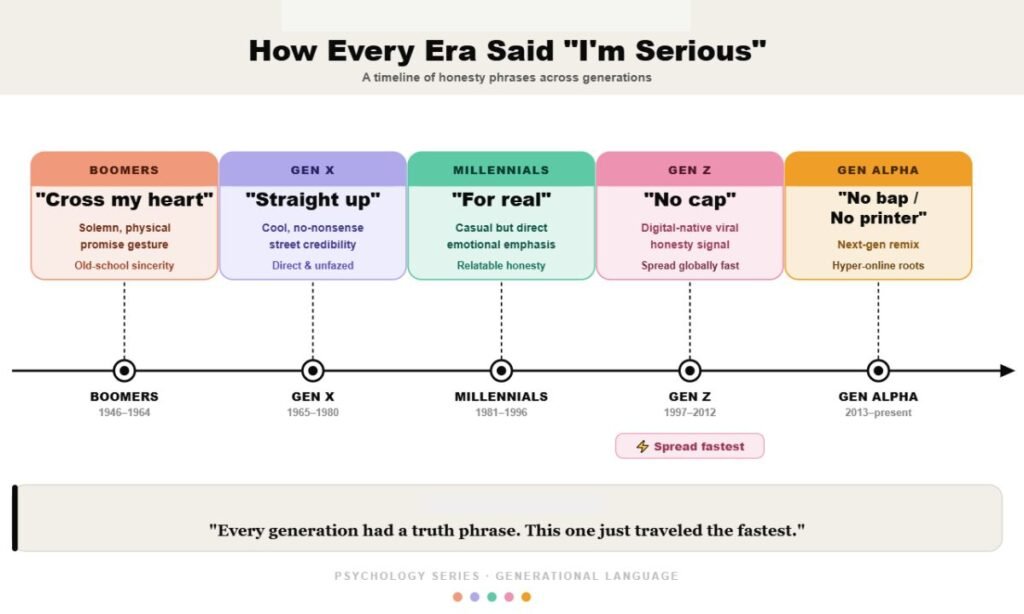
The words change every decade but the need behind them never does. No cap meaning in text is just the 2026 version of a need that every generation has always had.
Humans have always needed a way to signal sincerity to each other. “No cap” is just the current version of something that has existed in every generation’s vocabulary. What shifts is the packaging, the cultural context, and how fast it spreads.
Here’s how it looked across generations:
- Gen Alpha (2026): “no cap,” “no bap,” “fr fr,” “no printer.”
- Gen Z: “no cap,” “deadass,” “on God,” “no lies.”
- Millennials: “for real,” “I’m dead serious,” “no joke,” “swear to God.”
- Gen X: “straight up,” “I kid you not,” “no BS,” “seriously though.”
- Baby Boomers: “honest to God,” “I mean it,” “no kidding,” “cross my heart.”
What separates Gen Z from every generation before it is reach. A Millennial phrase took years and radio airplay to cross from one city to another. TikTok moved “no cap” from Atlanta to Karachi, London, and Manila in a matter of months. The algorithm did what geography used to prevent.
But underneath all of it the function stays identical. Every generation needed strangers and friends alike to believe them. The phrase changes. The need to be trusted never does.
“No Cap” for ESL and Non-Native English Speakers
Your English teacher never covered no cap meaning in text or slang and that gap shows up the moment you go online.
There’s a real difference between the English taught in classrooms and the English people actually use in 2026. Textbooks give you grammar. TikTok gives you how people talk when nobody’s grading them. Most non-native English speakers encounter “no cap” through a subtitle, a comment section, or a friend who grew up watching American YouTube. No explanation comes with it. You just see it and try to figure it out from context.
The context actually matters a lot here. Safe situations for using it:
- Casual chats with friends your age who already use it.
- Social media captions where the tone is relaxed and informal.
- Group messages where everyone is already online in that way.
Situations where you leave it out completely:
- Any email to a professor, employer, or client.
- Academic writing, exams, or formal presentations.
- Conversations with older adults who aren’t on social media.
English slang for Pakistanis, Indians, and Middle Eastern speakers is already spreading naturally through local online communities. If you’ve seen “no cap” used enough times to feel its meaning without thinking, you’re ready. If you’re still unsure, give it more time. The best approach is simple: watch it land naturally in real conversations five times before you try it yourself. When you need formal English, “in fact,” “honestly,” or “I’m not exaggerating” all do the same job without the slang baggage.
Cultural Sensitivity — Who Owns “No Cap”?
Most articles skip this section entirely and that’s exactly the problem.
“No cap” is AAVE, African American Vernacular English. Not a Gen Z invention. Not something the internet created. Describing it that way erases the community that built it, used it for decades, and pushed it into global vocabulary through music and culture. AAVE slang credit gets dropped constantly in mainstream conversations and the omission is not accidental, it’s just convenient.
There’s a term worth knowing: “Columbusing” language. It means arriving somewhere that was never empty, planting a flag, and calling it a discovery. Linguist Geneva Smitherman documented how AAVE moves from Black cultural spaces into mainstream use, and how that credit rarely travels with it. When non-Black users flood social media with AAVE while describing it as something “Gen Z made up,” real history gets quietly overwritten.
Using it responsibly doesn’t require a disclaimer every time you type it. It requires knowing where it came from:
- It came from AAVE, specifically from Atlanta hip-hop culture around 2012.
- Future and Young Thug, both Black artists, gave it its mainstream moment in 2017.
- Calling it an internet trend instead of acknowledging that erases their contribution.
- Performing AAVE as an aesthetic while ignoring its roots is a different thing entirely.
Knowing the origin doesn’t make using the slang wrong. It just makes you honest. Which, for a phrase that literally means “no lie,” is the least you can do.
Common Mistakes When Using “No Cap”

A few of these will just confuse people. One of them will genuinely embarrass you. Most mistakes happen because people skip learning the actual no cap meaning in text before using it.
The most common misuse of cap slang is thinking “cap” means cool or impressive. It never has. It means lie. Walk up to someone, point at their outfit and say “no cap” when you mean “that’s fire” and you’ve just told them you’re not lying about something you haven’t even said yet. Completely different sentence. Another no cap wrong usage that catches people off guard: mixing it up with “no crap,” which is a separate phrase and depending on who’s around, can land as rude.
Here’s what to avoid:
- Using “cap” to mean impressive or cool. It means lie, full stop.
- Swapping “no cap” for “no crap” without realizing they’re different phrases.
- Saying it after every sentence until it loses all meaning.
- Putting it in a professional email or cover letter. It reads like a meme in a legal document.
- Spelling it “nocap” as one word anywhere that matters. Looks unintentional.
- Using it sarcastically without a clear signal. Text carries no facial expression and confusion follows fast.
- Dropping it around people unfamiliar with internet culture. You’ll spend five minutes explaining instead of having the conversation you meant to have.
- Saying “cap” to someone mid-argument when the mood is already tense. The word stops feeling casual quickly depending on tone.
The simplest test for how to use no cap correctly: swap it for “no lie” in the same sentence. If it sounds natural, you’re good. If it sounds off, rethink it.
How to Respond When Someone Says “No Cap” or “That’s Cap”
First read the room, then pick your reply.
When someone says “no cap” they’re putting their honesty forward and leaving space for you to meet them there. When someone hits you with “that’s cap” they’re calling you out, either as a joke or as a genuine challenge. The words are the same in both cases. The tone tells you everything.
When they say “no cap” and mean it:
- “Facts, that lines up with what I saw too.”
- “No cap right back, same thing happened to me.”
- “Yeah I believe that, it makes sense.”
When “that’s cap” is clearly playful:
- “Cap? I don’t even own a hat. 😂”
- “Show you the proof right now, cap check passed.”
- “My honesty is undefeated, ask anyone.”
When the tone shifts more serious:
- “I get why it sounds off but I’m telling you exactly what happened.”
- “I’m not stretching this at all. That’s the whole story.”
- “Anyone who was there will say the same thing.”
When someone says you’re capping mid-conversation:
- Light energy: “Bro I have zero reason to cap about this.”
- Doubling down: “No cap fr, I was standing right there.”
- Staying calm: “I hear you. I’m telling you what actually happened.”
A laughing accusation wants a laughing reply. A serious one wants calm and direct. Matching their energy is always the right move.
Is “No Cap” Still Relevant in 2026?

Slang going out of style has a very specific look and “no cap” doesn’t have it yet.
Every phrase follows the same path. Born in one community, goes viral, hits mainstream, then either becomes part of everyday language or quietly disappears. The ones that disappear fast are usually tied to a single moment, a meme, a specific week online. When that moment expires, the word expires with it. “No cap” never had that problem because it wasn’t attached to a moment. It was attached to a feeling.
So is no cap dead in 2026? No. Is cap slang still popular the way it was in 2019? Also no. It’s sitting in the middle, which is actually where language lives the longest.
Two signs tell you when slang is genuinely fading:
- Older generations start using it completely straight, no irony, no awareness.
- It shows up in brand marketing and nobody finds it embarrassing anymore.
Neither has fully landed yet. It still appears in youth content without feeling like something your uncle would say. Gen Alpha is shifting toward “no bap,” “no printer,” and “on foe” but that’s a generational handoff, not a replacement. Gen Z slang trends in 2026 still carry “no cap” in regular use.
Why it lasted while other phrases collapsed comes down to four things. Short. Easy to say. Emotionally useful in a way nothing else replaces cleanly. And never tied to one trend that could expire overnight. That combination is rare. Most slang gets maybe six months. “No cap” already has years behind it and based on where it sits right now, at least three to five more ahead.
Frequently Asked Questions
What does “no cap” mean in slang?
No cap meaning in text is simple — you are telling the truth and you want the other person to know it. No lie, no exaggeration, exactly what it sounds like. People drop it at the start or end of a sentence to put their honesty on the line.
What does “cap” mean when someone texts it?
They don’t believe you. “That’s cap” is a direct way of saying your story sounds like a lie or you’re stretching the truth. Short, blunt, no softening.
How do you pronounce “no cap”?
Noh KAP. The stress lands on the second word, not the first. It rhymes with tap and map. Say it fast and casual, not slow and deliberate.
Is “no cap” the same as “for real”?
Similar function, different cultural weight. “For real” works across every generation and most situations. “No cap” is more specifically tied to Gen Z and AAVE. They’re interchangeable sometimes but not always identical in energy.
Where did “no cap” originally come from?
African American Vernacular English, with roots going back to the early 1900s. It connected to Atlanta hip-hop culture around 2012 and went fully mainstream when Future and Young Thug released the song No Cap in 2017.
What does “you’re capping” mean?
You’re lying right now, actively, in real time. It’s a live callout. More direct than “that’s cap” because it’s pointed at the person’s behavior in the moment.
Is “no cap” rude or offensive?
Generally no. It’s casual slang and usually lands as playful. The exception is tone. Calling someone out as “capping” during a genuine argument stops feeling light very quickly depending on how it’s delivered.
Is “no cap” cultural appropriation?
It comes from AAVE. Using it while knowing that is fine. Using it while calling it a “Gen Z thing” or claiming it came from the internet erases where it actually started and who built it.
Can I use “no cap” in professional settings?
No. Informal only. It doesn’t belong in emails, meetings, academic writing, or job interviews. If you’re unsure whether the setting is casual enough, it probably isn’t.
Is “no cap” still popular in 2026?
Yes. It moved from trend slang to settled slang, meaning it’s no longer new but it’s not embarrassing either. Still used regularly online and in Gen Z conversations without feeling forced or outdated.
Conclusion
Two words. One job. Done perfectly. No cap meaning in text, slang and real conversations all comes down to one thing — honesty delivered in two words.
“No cap” exists because the internet created a honesty problem. When every caption performs, every post is angled, and every opinion comes with an agenda, saying something genuinely real became rare enough to need its own phrase. That’s why this one lasted.
Short phrases with real emotional weight outlast clever ones that don’t deliver. “No cap” carried both. It left Atlanta as hip-hop slang rooted in AAVE and arrived everywhere else as a globally understood honesty signal. Cap slang traveled that distance because it filled something people actually needed, not because a trend pushed it.
You now know the full no cap meaning, its roots in AAVE, how it moved through hip-hop culture, where to use it, and exactly where to leave it out. Most people who say it daily know maybe half of that.
No cap.

Emily here. I write about puns, slang, and the quirky side of language because words are funnier than people give them credit for. Four years in, and I still laugh at my own jokes. Someone has to.
