

If you have seen “SFS” in a text message, Instagram comment, Snapchat post, or online conversation, you may wonder what it means. SFS is a short abbreviation with more than one possible meaning, so the correct definition depends on the context. In social media conversations, SFS most commonly means “Shoutout for Shoutout” or “Snap for Snap.” People use it when they want to exchange promotion, mentions, or social media interactions with another person.
For example, someone might message, “SFS?” when asking another user if they want to promote each other’s accounts. On Snapchat, SFS can also refer to exchanging snaps. In other situations, SFS can have completely different meanings, especially in business, technology, education, and everyday communication.
In this article, I’ll explain what SFS means, how people use it in texting and social media, what it means on Snapchat and Instagram, and how you can knowing it correctly from the conversation around it.
What Does SFS Mean in Texting?
In texting and casual online conversations, SFS usually means “Shoutout for Shoutout.” It describes an agreement between two people to promote each other.
The idea is simple. One person gives another person a shoutout, mention, or recommendation to their followers. The other person does the same in return. This allows both people to reach a larger audience without paying for traditional advertising.
For example, imagine that I run a small social media account and another person has an account with a similar audience. I might send:
“Hey, SFS?”
If they agree, we may each post something that mentions the other person’s account.
SFS can be useful for creators, small businesses, influencers, photographers, artists, and people trying to grow their social media accounts. The exact method depends on the platform. One person might post a story, share a profile, tag another account, or recommend someone to their followers.
Because SFS is informal slang, people may not always spell out the full phrase. They may simply write “SFS?”, “SFS!”, or “Anyone up for SFS?”
The surrounding conversation is important. If someone is discussing social media growth, followers, stories, or account promotion, “Shoutout for Shoutout” is usually the intended meaning.
SFS Meaning on Snapchat
On Snapchat, SFS can mean “Snap for Snap.” It can also be used for “Shoutout for Shoutout,” depending on the person and the conversation.
When SFS means “Snap for Snap,” it generally refers to exchanging snaps with another person. The idea is that both people send snaps to each other, often to maintain interaction or increase activity.
For example, someone might say:
“Want to do SFS?”
They could be asking whether you want to exchange snaps.
Snapchat users may also use SFS when they are trying to increase attention around their accounts. Someone could post an SFS message and ask other users to participate.
This is why the abbreviation can be confusing. Two Snapchat users might use the same three letters while intending slightly different things.
If the conversation mentions snaps, streaks, stories, or Snapchat usernames, “Snap for Snap” may fit the context. If it mentions followers, promotion, accounts, or shoutouts, “Shoutout for Shoutout” is more likely.
SFS Meaning on Instagram
On Instagram, SFS commonly refers to “Shoutout for Shoutout.”
Instagram users may use SFS when they want to promote one another. This can happen through Instagram Stories, posts, reels, or profile recommendations.
For example, I might see a message like:
“Your page is great. SFS?”
In this situation, the person is probably asking whether we can promote each other’s Instagram accounts.
A typical SFS arrangement works like this: one account shares the other account with its audience, and the second account returns the promotion. The goal is to introduce each account to people who may be interested in its content.
SFS can be especially common among smaller accounts. A person with 2,000 followers might connect with another account that has a similar audience and exchange promotions.
However, an SFS request does not automatically mean that the other person has agreed to anything. It is simply an invitation or request. If you receive one, you can decide whether you want to participate.
What Does “SFS” Mean on Snapchat Story?
When someone posts “SFS” on a Snapchat Story, they are often asking other users to participate in a shoutout or snap exchange.
The exact meaning can vary.
For example:
SFS — add me
could be a request related to exchanging snaps or promoting accounts.
Another person might post:
SFS? Send me your username.
Here, the purpose is likely to connect with other users and exchange exposure or snaps.
Snapchat slang can change between communities, so it is better to consider the surrounding words instead of assuming that SFS always has one fixed definition.
If the Story contains usernames, tags, follower-related language, or requests to share accounts, SFS probably relates to promotion. If it focuses on sending snaps, it may mean “Snap for Snap.”
What Does SFS Mean on Instagram Story?
On an Instagram Story, SFS usually refers to sharing or promoting each other’s accounts.
Someone might post:
“SFS? DM me.”
This usually means they are inviting other users to message them if they want to arrange a shoutout.
An Instagram SFS may involve sharing another person’s profile in a Story and tagging that account. The other person may then do something similar.
For example, I could share someone’s photography account on my Story and tell my followers to check it out. That person could then share my account with their audience.
The purpose is normally audience growth or exposure. It is different from simply tagging someone in a post because SFS usually suggests that the promotion will be mutual.
SFS vs. Shoutout
A shoutout and an SFS are related, but they are not exactly the same.
A shoutout is a general mention or promotion of another person or account. It does not necessarily require the other person to promote you.
SFS specifically suggests an exchange. One person gives a shoutout, and the other person gives one back.
For example:
Shoutout:
“I really like this photography page. Follow them!”
SFS:
“I’ll share your photography page if you share mine.”
The difference is the exchange.
This distinction matters because someone asking for SFS is usually asking for mutual promotion rather than simply requesting a one-way recommendation.
Why Do People Use SFS?
People use SFS mainly to gain exposure and interaction on social media.
When two accounts promote each other, their content can reach people who have not seen it before. This can potentially bring new followers, views, comments, or profile visits.
SFS is particularly useful when two accounts have related audiences. For example, a fitness page might exchange a shoutout with another fitness page. A food account might promote another food account. A photography page could work with another photography creator.
The usefulness of an SFS depends on several factors. Audience quality matters more than simply looking at follower numbers. If the audiences have no interest in each other’s content, an exchange may not produce much value.
Some people also use SFS simply as a way to meet other creators and become part of a social media community.
How Does an SFS Work?
An SFS arrangement is usually straightforward.
First, one person asks another person whether they want to do SFS. If both people agree, they decide what they will share and when they will share it.
One person may create a Story featuring the other account. They might include the account’s username, a photo, a short recommendation, or a link to the profile.
The second person then creates a similar post or Story promoting the first account.
For example:
Person A: “Want to do SFS?”
Person B: “Sure.”
Person A: “I’ll post yours tonight. You can post mine tomorrow.”
Both people then follow through with the agreement.
There is no universal SFS rule. Each person can decide what kind of promotion they are comfortable with.
What Does SFS Mean in Social Media Slang?
In social media slang, SFS generally refers to a mutual exchange of promotion or interaction.
The most common interpretations include:
Shoutout for Shoutout — two users promote each other’s accounts.
Snap for Snap — two Snapchat users exchange snaps.
The intended meaning depends on the platform and conversation.
Social media abbreviations often develop differently across communities. That means an abbreviation can have several meanings without one of them being “wrong.”
For example, if someone sends “SFS?” after discussing Instagram followers, I would knowing it differently than if someone uses SFS while talking specifically about sending Snapchat messages.
SFS Examples in Text Messages
Here are some simple examples of how SFS can appear in a conversation.
Example 1:
“Your page has good content. SFS?”
This likely means the person wants to exchange promotional posts.
Example 2:
“Anyone doing SFS today?”
This suggests the person is looking for others who want to exchange shoutouts.
Example 3:
“SFS on IG?”
The person is likely asking about an Instagram shoutout exchange.
Example 4:
“Want to do SFS on Snap?”
This could mean “Snap for Snap” or a Snapchat-based shoutout exchange.
Example 5:
“DM me for SFS.”
This means the person wants interested users to contact them privately about an SFS arrangement.
The key is to look at the words around SFS. Context usually makes the intended meaning clear.
How Should I Reply to “SFS?”
Your response depends on whether you want to participate.
If you are interested, you can reply:
“Sure, send me your account.”
Or:
“Yeah, I’m interested. What did you have in mind?”
If you are not interested, you can simply say:
“No thanks.”
You do not have to agree to an SFS request just because someone asks.
If you are unsure what they mean, the easiest response is:
“What do you mean by SFS?”
That gives the other person a chance to explain whether they mean “Shoutout for Shoutout,” “Snap for Snap,” or something else.
Is SFS the Same as Follow for Follow?
No. SFS and F4F are different abbreviations.
SFS generally involves exchanging shoutouts or snaps, while F4F usually means “Follow for Follow.”
With F4F, two people agree to follow each other’s accounts.
With SFS, two people generally agree to promote or interact with each other’s accounts.
For example:
F4F:
“I’ll follow you if you follow me.”
SFS:
“I’ll promote your account if you promote mine.”
They can sometimes be used together, but they describe different actions.
SFS vs. F4F vs. L4L
Social media users may also encounter F4F and L4L alongside SFS.
F4F means “Follow for Follow.”
L4L means “Like for Like.”
SFS commonly means “Shoutout for Shoutout” or “Snap for Snap.”
These abbreviations describe different types of social media exchanges.
For example, F4F focuses on followers, L4L focuses on likes, and SFS usually focuses on promotion or snaps.
Understanding these differences can make social media conversations much easier to follow, especially when someone sends several abbreviations in the same message.
Other Meanings of SFS
Although SFS is common as social media slang, it can mean other things in different fields.
This is important because not every use of SFS is related to texting.
In business, technology, education, medicine, transportation, engineering, and other areas, SFS may be an acronym for a completely different phrase.
For example, a person working in a specialized industry may use SFS as an internal abbreviation that has nothing to do with social media.
This is why I would not automatically interpret every occurrence of SFS as “Shoutout for Shoutout.” The surrounding subject matters.
If you see SFS in a professional email, academic document, technical report, or workplace message, look at the context before assuming it refers to social media slang.
SFS in a Professional Conversation
If SFS appears in a professional conversation, it is worth checking the surrounding information carefully.
A message such as:
“Please review the SFS document before Friday.”
does not sound like social media slang. The abbreviation may refer to a specific organization, process, document, system, or technical term.
Workplaces often create abbreviations for departments, software, procedures, and projects. Some of these abbreviations can be shared by unrelated organizations.
Therefore, the meaning of SFS in professional communication cannot be determined from the three letters alone.
If you are unsure, asking the sender what SFS stands for is usually the safest option.
Does SFS Always Mean Shoutout for Shoutout?
No. SFS does not always mean “Shoutout for Shoutout.”
That is one of the most important things to remember.
In social media conversations, “Shoutout for Shoutout” is a common interpretation. On Snapchat, “Snap for Snap” may also be intended.
Outside social media, SFS can represent other phrases.
The best way to identify the correct meaning is to consider:
- Which platform is being used?
- What are the people talking about?
- Are followers or accounts mentioned?
- Are snaps being discussed?
- Is the conversation professional or technical?
- Does the person explain SFS elsewhere in the message?
You do not need to memorize every possible definition. Context usually gives you the answer.
Why SFS Can Be Confusing
SFS is confusing because it contains only three letters but can represent multiple phrases.
Many internet abbreviations work this way. Their meanings depend on the platform, age group, online community, and subject of the conversation.
For example, a person on Instagram may use SFS to mean “Shoutout for Shoutout.” Someone on Snapchat may use it to mean “Snap for Snap.” Someone in a workplace could use SFS as an abbreviation for something completely unrelated.
This is why dictionary-style definitions do not always tell the whole story.
When I see an unfamiliar abbreviation, I find it helpful to look at the complete sentence instead of interpreting the abbreviation by itself. The surrounding words often provide enough information to understand what the person means.
Is SFS a Good Way to Grow Social Media Accounts?
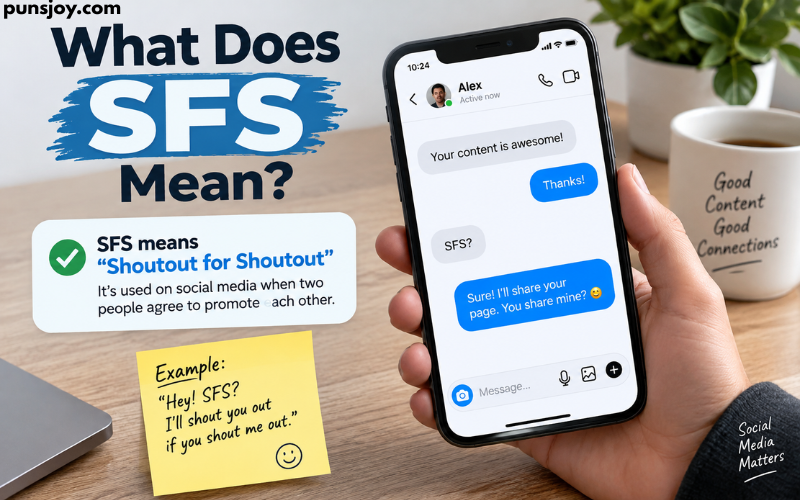
SFS can provide a way for social media users to introduce their accounts to new audiences, but the result can vary.
An account may receive new visitors after being mentioned by another creator. However, gaining exposure does not guarantee that those visitors will become followers or regularly engage with the content.
The relevance of the audience matters. A shoutout from an account whose followers have no interest in your content may have little effect.
It is also important to be clear about what you are agreeing to. Before participating, you can discuss what will be posted, how long it will remain visible, and whether both accounts will provide similar promotion.
An SFS works best when both sides understand the arrangement.
Related Post: What Does IMY Mean in Text?
Things to Check Before Doing SFS
If someone asks you to do SFS, I recommend checking the account and understanding the agreement before sharing anything.
Look at the account’s content and make sure you are comfortable recommending it to your audience. You can also ask exactly what they expect from the exchange.
For example, you might ask:
“Do you want a Story mention or a post?”
You can also clarify timing:
“When should we post the shoutouts?”
If the account asks you to share something that you do not want associated with your profile, you can decline.
An SFS is optional. You should only participate when the arrangement makes sense for you and your account.
FAQs
What does SFS stand for?
In social media slang, SFS most commonly stands for “Shoutout for Shoutout.” On Snapchat, it can also mean “Snap for Snap.” The intended meaning depends on context.
What does SFS mean on Instagram?
On Instagram, SFS generally means “Shoutout for Shoutout.” It usually refers to two accounts agreeing to promote each other.
What does SFS mean on Snapchat?
On Snapchat, SFS can mean “Snap for Snap” or “Shoutout for Shoutout.” Look at the surrounding conversation to determine which meaning is intended.
What does SFS mean in a text?
In a casual text involving social media, SFS commonly means “Shoutout for Shoutout.” If the conversation involves Snapchat, it may mean “Snap for Snap.”
What should I reply to SFS?
If you are interested, you can ask what kind of SFS the person wants. For example, “Sure, what did you have in mind?” If you are unsure, simply ask, “What does SFS mean here?”
Is SFS the same as F4F?
No. SFS usually refers to a shoutout or snap exchange, while F4F means “Follow for Follow.” They describe different types of social media interactions.
What does SFS mean on an Instagram Story?
SFS on an Instagram Story usually refers to a shoutout exchange. The person may be asking other users to promote each other’s accounts.
Does SFS have meanings outside social media?
Yes. SFS can be an acronym for different terms in professional, technical, academic, and other settings. The meaning depends on the subject and context.
Can SFS mean “Sorry for Something”?
It can potentially be used that way in an individual conversation, but that is not the standard social media meaning. If someone uses SFS in an unusual way, the surrounding message is the best clue.
What is the simplest meaning of SFS?
The simplest social media definition is “Shoutout for Shoutout,” meaning two people agree to promote each other’s accounts. On Snapchat, it can also mean “Snap for Snap.”
Conclusion
So, what does SFS mean? In most casual social media conversations, SFS means “Shoutout for Shoutout.” It describes an arrangement where two people promote each other’s accounts. On Snapchat, SFS can also mean “Snap for Snap,” referring to exchanging snaps.
The correct meaning depends on where you see it and what the conversation is about. If someone writes “SFS?” while talking about Instagram followers or account promotion, they probably mean “Shoutout for Shoutout.” If they are discussing Snapchat and sending snaps, “Snap for Snap” may be the intended meaning.
SFS can also have unrelated meanings in professional and technical settings. When the context is unclear, asking the person what they mean is the easiest way to avoid misunderstanding.

Emily here. I write about puns, slang, and the quirky side of language because words are funnier than people give them credit for. Four years in, and I still laugh at my own jokes. Someone has to.
