

If you have seen JSP in a text message, online conversation, school discussion, workplace, or technology-related content, you may wonder what it means. The meaning of JSP depends on the context where you see it. In most cases, JSP can refer to JavaServer Pages, a technology used to create dynamic web pages with Java. In casual online communication, however, people may use JSP as an abbreviation for something completely different.
I find JSP interesting because it is one of those abbreviations that can be confusing when there is no context. A person talking about programming may use JSP to describe a web development technology, while someone using it in a message may have another meaning in mind. That is why looking at the surrounding words is important before deciding what JSP means.
In this article, I will explain the common meanings of JSP, with a main focus on JSP as JavaServer Pages. I will also cover how JSP works, where it is used, examples, advantages and limitations, and how you can tell which meaning applies to your situation.
What Does JSP Mean?
JSP most commonly means JavaServer Pages, a server-side web technology associated with Java. It allows developers to create web pages whose content can be generated dynamically on a web server.
The name can be broken into two parts. “Java” refers to the Java programming language and platform, while “Server Pages” describes web pages processed on the server before the resulting content is sent to a visitor’s browser.
For example, imagine a website that shows a customer’s name after they sign in. The page may need information from a database. Instead of sending the database information directly to the browser, a server can process the request, generate the appropriate HTML, and send the finished page to the user. JSP was designed to support this type of server-side web application.
JSP files commonly use the .jsp file extension. A JSP page can contain normal HTML along with JSP elements and expressions that allow the page to work with dynamic information.
However, JSP does not have only one possible meaning. If you see “JSP” in a text or social media message, the intended meaning may be different. Context is the best way to determine what someone means.
What Is JSP in Simple Words?
In simple terms, JSP is a way to create web pages that can change based on information processed by a server.
Think about a normal HTML page. The browser receives the HTML and displays it. A JSP page can contain instructions that are processed on the server first. The server can use information from a database, user input, an application, or another source to create the response.
For example, a website might need to display:
“Welcome, John.”
The word “John” could come from information stored for the logged-in user. A JSP-based application can help generate that personalized content on the server.
I think of JSP as a bridge between a web page and Java-based server-side application logic. It was especially useful for developers building Java web applications where the response needed to contain both HTML and information generated by the application.
What Is JavaServer Pages?
JavaServer Pages, commonly shortened to JSP, is a technology for creating dynamic web content on the server.
JSP was developed as part of the Java web technology ecosystem. A JSP page is ultimately processed by a web container or application server. The server handles the JSP page and produces a response, commonly HTML, that can be sent to a web browser.
One important point is that JSP is not simply another name for HTML. HTML describes the structure and content of a web page, while JSP provides a way for server-side Java web applications to generate dynamic content within that page.
A JSP file may contain standard HTML elements such as headings, paragraphs, tables, and forms. It can also contain JSP-specific elements and expressions.
This combination made JSP useful for developers who wanted to create web applications where the content shown to visitors depended on information available on the server.
How Does JSP Work?
The basic JSP process happens on the server.
When a user requests a JSP page, the request goes to a web server or application server that supports JSP. The server processes the page and generates a response. The browser receives the resulting content rather than receiving the original JSP source code.
A simplified process looks like this:
User → Web Browser → Web Server/Application Server → JSP Processing → HTML Response → Browser
Suppose a visitor requests a page called profile.jsp. The server receives that request and processes the JSP page. If the page needs information from a database, the application can obtain that information and use it while creating the response.
The browser then receives the generated HTML and displays it.
This server-side processing is an important part of understanding JSP. The browser does not normally execute the JSP instructions itself. The JSP page is processed on the server.
What Is a JSP File?
A JSP file is a web page file that normally uses the .jsp extension.
For example:
index.jsp
A JSP file can contain HTML and JSP elements. Historically, developers could also place Java code directly inside JSP pages using scriptlets. However, modern Java web development generally favors separating presentation from application logic rather than putting large amounts of Java code directly into a JSP file.
A very simple JSP page might look similar to this:
<html>
<body>
<h1>Welcome to my website</h1>
</body>
</html>
That example looks almost like ordinary HTML because JSP pages can contain standard HTML.
The dynamic part comes when JSP features are used to insert or generate information during server-side processing.
What Is JSP Used For?
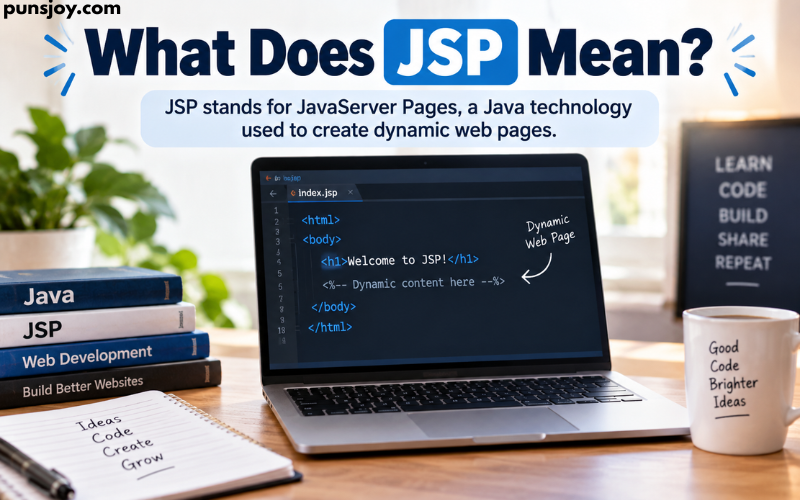
JSP has been used for many types of Java-based web applications.
Common uses include websites, internal business systems, database-driven applications, online forms, customer portals, administrative interfaces, and other server-side applications.
For example, a company might have an internal employee portal. After an employee signs in, the application could display their name, department, messages, and account information. A JSP page could be used as part of the presentation layer that displays this information.
JSP has also been used for pages that need information from databases. A product page, for example, might display product names, prices, descriptions, and availability based on data retrieved by the application.
JSP can also work with Java-based frameworks and other components of a web application. Its role is generally associated with the presentation or view layer rather than being the entire application by itself.
JSP Example
Here is a simple conceptual example of what JSP can do.
Imagine a website has a page that displays a user’s name. The application has already identified the user as Sarah.
The JSP page could generate a response that contains:
<h1>Welcome, Sarah!</h1>
The important part is that “Sarah” does not have to be permanently written into the page. The application can obtain the user’s information and generate the appropriate response.
If another user named Michael signs in, the generated page could instead contain:
<h1>Welcome, Michael!</h1>
This is the basic idea behind dynamic web content. The same JSP page can produce different output depending on the information available during the request.
JSP and HTML: What Is the Difference?
JSP and HTML are related, but they are not the same thing.
HTML is a markup language used to structure content displayed in a web browser. It defines elements such as headings, paragraphs, links, images, tables, and forms.
JSP is a server-side web technology that can be used to generate dynamic web content, often producing HTML as its output.
For example, HTML can define:
<h1>Welcome</h1>
A JSP application could generate a personalized version:
<h1>Welcome, Sarah</h1>
The browser ultimately receives HTML. JSP is involved earlier, on the server, when the response is created.
So, HTML is part of what the browser displays, while JSP can be part of how that content is generated.
JSP vs Java
JSP is closely connected to Java, but JSP and Java are not the same thing.
Java is a general-purpose programming language and technology platform. It can be used to build many types of software, including web applications, desktop applications, enterprise systems, and more.
JSP is specifically associated with server-side web page generation in the Java web ecosystem.
A Java application can contain business logic, data access, services, and other components. JSP may be used to present the results of that application to a web user.
For example, Java code might handle the calculation of an order total, while a JSP page could display that total in an HTML page.
Keeping those responsibilities separate can make an application easier to maintain.
JSP vs Servlet
JSP and Servlets are two related technologies used in Java web development, but they serve different roles.
A Servlet is a Java class designed to handle requests and responses in a web application. It can receive a request, perform processing, communicate with other application components, and produce a response.
JSP focuses more heavily on generating the presentation or view.
There is also an important technical relationship between them. A JSP page is translated into a Servlet by the JSP container and then compiled and executed as needed. This means JSP is not an entirely separate execution system from Servlets.
A simple way to remember the distinction is:
Servlet: Java code that handles web requests.
JSP: A server-side page technology designed to make dynamic web presentation easier.
In many traditional Java web applications, Servlets and JSP were used together.
Why Was JSP Created?
Before technologies such as JSP became common, developers had to write more of the HTML output directly inside Java code when building Java web applications.
That approach could become difficult to read because the Java code and HTML markup became heavily mixed.
JSP offered a page-oriented approach where developers could start with HTML and add dynamic server-side elements where necessary.
This made it more convenient to create pages containing both static markup and dynamic information.
Over time, Java web development practices evolved. Developers increasingly adopted frameworks, templating technologies, and architectural patterns that separated application logic from presentation. Even so, JSP remains important for knowing many existing Java enterprise applications.
Advantages of JSP
JSP has several characteristics that made it useful in Java web development.
Easy Integration With Java
JSP was designed to work within the Java web ecosystem. This made it a natural option for applications already using Java technologies.
Developers could connect JSP pages with Java classes, Servlets, databases, and other application components.
Supports Dynamic Content
One of the main reasons to use JSP is the ability to generate content dynamically.
A page can display different information based on a user’s request, session, database records, or application state.
Works With HTML
JSP pages can contain ordinary HTML. This makes the basic structure familiar to people who already understand web markup.
Developers can create a normal HTML structure and add dynamic features where needed.
Useful for Existing Java Applications
Many organizations have older or long-running Java applications. Some of these applications use JSP for their presentation layer.
Understanding JSP can therefore be useful when maintaining or updating an existing system.
Limitations of JSP
JSP also has limitations, especially when compared with newer web development approaches.
One issue is that JSP applications can become difficult to maintain if too much Java code is placed directly inside pages. Mixing large amounts of application logic with presentation markup can make the code harder to understand.
Modern development practices generally encourage developers to keep business logic outside the view.
Another consideration is that newer Java web frameworks and front-end technologies have changed how developers build applications. Depending on the project, a team may choose a different templating system or architecture instead of JSP.
JSP is therefore not automatically the right choice for every new web project. Its usefulness depends on the application, technology stack, team, and existing infrastructure.
Is JSP Still Used?
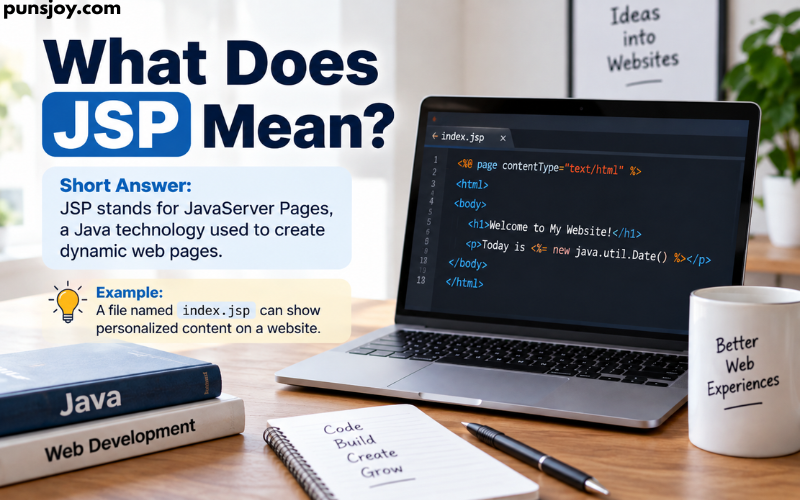
Yes, JSP can still be found in existing Java web applications.
It is important to separate two questions: whether JSP exists and whether it is the preferred choice for every new application. These are not the same.
Large organizations often maintain software that was created years ago. Replacing an entire application simply because a newer technology exists can be expensive and risky. As a result, JSP may remain part of systems that are still actively maintained.
For someone learning Java web development, understanding JSP can also help when working with older enterprise applications.
At the same time, developers building a new application have many other technologies available. The best choice depends on the project’s requirements and architecture.
Common JSP Terms You May See
If you are learning JSP, several related terms may appear frequently.
JSP page: A web page containing JSP elements and usually HTML.
JSP container: The component responsible for processing JSP pages.
Servlet: A Java class used to handle web requests and responses.
JSTL: The JavaServer Pages Standard Tag Library, which provides reusable tags for common tasks.
Expression Language (EL): A syntax used to access data and perform expressions in Java web technologies.
JavaBean: A Java class following conventions that can be used to represent and manage data.
Application server: Software that can provide the environment required to run Java web applications and related components.
Knowing these terms makes JSP documentation and older Java projects much easier to knowing
What Does JSP Mean in Texting?
The meaning of JSP can change when it appears in texting or casual online conversations.
Unlike JSP meaning JavaServer Pages, which has a clear technical definition, abbreviations used in messages are often informal. Different communities may use the same letters for different phrases.
Because of this, I would not assume that JSP always means JavaServer Pages when someone sends it in a text.
The surrounding sentence is important. Look at the words before and after JSP, the subject of the conversation, and the relationship between the people communicating.
If the conversation is about programming, websites, Java, coding, or software development, JavaServer Pages is a strong possibility. If the conversation is casual and contains no technology-related discussion, JSP may have another meaning.
Why Context Matters With JSP
Abbreviations are often difficult because three letters can represent several different things.
For example, imagine someone writes:
“I am learning JSP for my Java project.”
Here, the meaning is clearly related to Java web development.
Now imagine someone sends:
“JSP 😂”
without any additional information. There is not enough context to confidently determine what the person means.
This is why dictionary-style abbreviation lists should not always be treated as proof of the intended meaning in a particular conversation.
When I see an unfamiliar abbreviation, I first look at the topic. If the discussion is about coding, I interpret JSP differently than I would in a casual text conversation.
Is JSP a Programming Language?
No, JSP is not a programming language.
JSP is a server-side web technology used to create dynamic web content in Java-based web applications.
Java is the programming language most closely associated with JSP.
This distinction is useful for beginners. Saying “I am learning JSP” is different from saying “I am learning Java.” JSP is a web development technology, while Java is a programming language and broader software platform.
JSP pages can contain Java-related elements, but JSP itself should not be described as a standalone programming language.
What Does .jsp Mean in a Website URL?
If you see a URL ending in .jsp, it often indicates that the requested resource is a JSP page.
For example:
example.com/account.jsp
The .jsp extension suggests that the server may be using JSP to process that page.
However, seeing .jsp in a URL does not tell you everything about the underlying application. Websites can hide extensions, use URL rewriting, or route requests through different systems.
It is also common for modern applications to use clean URLs that do not reveal the technology being used.
So .jsp is a useful clue, but it is not a complete description of a website’s architecture.
JSP and Databases
JSP can be part of an application that displays information retrieved from a database.
For example, consider an online employee directory. The database might contain an employee’s name, department, job title, and contact information.
A Java application can retrieve that information. The JSP view can then display the results in an HTML page.
The important design idea is that the JSP page does not need to be responsible for every database operation. In a well-structured application, database access and business logic are usually handled by separate components.
This separation helps developers maintain the system as it becomes larger.
JSP in MVC Architecture
JSP is often associated with the Model-View-Controller (MVC) pattern in traditional Java web applications.
The three parts have different responsibilities.
Model: Represents data and application-related logic.
View: Displays information to the user.
Controller: Handles requests and coordinates what should happen.
In this structure, JSP is commonly used as the View.
For example, a user might submit a login form. A controller handles the request, the application checks the credentials, and the appropriate information is then passed to a JSP page for display.
This approach helps prevent the presentation layer from becoming overloaded with business logic.
Who Should Learn JSP?
JSP can be useful for several groups of people.
Java developers working with older enterprise applications may need JSP knowledge to understand existing code.
Students learning traditional Java web development may encounter JSP in courses, books, or older tutorials.
Developers responsible for maintaining internal business systems may also encounter JSP pages in an existing application.
However, if you are completely new to web development, I would first build a foundation in HTML, HTTP, Java, and basic web application concepts. JSP becomes much easier to understand once those fundamentals are familiar.
Related Post: What Does NMMS Mean In Test?
FAQs
What does JSP stand for?
In Java web development, JSP stands for JavaServer Pages. It is a server-side technology used to create dynamic web content.
Is JSP the same as Java?
No. Java is a programming language and technology platform. JSP is a server-side web technology associated with Java web applications.
Is JSP a programming language?
No. JSP is not a standalone programming language. It is a technology for generating dynamic web pages on the server.
What is a JSP file?
A JSP file is usually a web page with a .jsp extension. It can contain HTML and JSP elements that are processed on the server.
What is JSP used for?
JSP has been used to create dynamic web pages and presentation layers for Java-based web applications.
Is JSP still used?
Yes. JSP continues to appear in existing Java web applications, particularly older enterprise systems. New projects may use other technologies depending on their requirements.
What is the difference between JSP and Servlet?
A Servlet is a Java class that handles web requests and responses, while JSP is a server-side page technology commonly used for presentation. JSP pages are processed into Servlets by the JSP container.
Does JSP run in the browser?
No. JSP is processed on the server. The browser normally receives the generated response, such as HTML.
What does .jsp mean in a URL?
A .jsp extension generally indicates that the requested resource is associated with a JSP page, although URL extensions do not always reveal the complete technology behind a website.
Can JSP connect to a database?
JSP can be part of an application that works with database information. In a well-designed application, database access is generally handled by separate Java components rather than directly inside the JSP page.
Is JSP only used for Java?
JSP is specifically part of the Java web technology ecosystem. Its main purpose is server-side web content generation in Java-based applications.
Does JSP have meanings outside technology?
Yes. JSP can be used as an abbreviation for other phrases, especially in informal communication. The intended meaning depends on context.
How to Identify the Meaning of JSP
When you encounter JSP, I recommend checking the subject of the conversation before choosing a definition.
If you see words such as Java, Servlet, web application, server, HTML, programming, coding, JavaBean, database, or developer, JSP probably refers to JavaServer Pages.
If the abbreviation appears in a casual message, social media post, or personal conversation, do not automatically assume it has the technical meaning.
You can also ask the person what they mean. A quick clarification is often easier than interpreting an abbreviation incorrectly.
Conclusion
So, what does JSP mean? In the technology world, JSP usually means JavaServer Pages, a server-side web technology used to generate dynamic web content in Java-based applications. JSP pages can contain HTML and JSP elements, and they are processed on the server before a response is sent to the browser.
JSP has played an important role in traditional Java web development and can still be found in many existing applications. It is closely related to technologies such as Servlets, JavaBeans, JSTL, Expression Language, and MVC architecture.
At the same time, JSP can have other meanings in casual communication. If you see the abbreviation in a text or social media conversation, the surrounding context matters. The safest way to knowing it is to look at what the conversation is about.
If the discussion involves Java or web development, JavaServer Pages is the meaning you are most likely looking for.

Emily here. I write about puns, slang, and the quirky side of language because words are funnier than people give them credit for. Four years in, and I still laugh at my own jokes. Someone has to.
