

If you have ever received a text message, you have probably used SMS without even thinking about it. SMS stands for Short Message Service. It is a system that allows people to send and receive short text messages using mobile phones and cellular networks.
When I send a normal text message from my phone to another phone number, it may be sent as an SMS. The technology has been around for decades, but it is still widely used today. SMS is used for personal messages, appointment reminders, verification codes, delivery updates, banking alerts, business notifications, and many other purposes.
In this guide, I will explain what SMS means, how SMS works, what an SMS message looks like, how it differs from MMS and other messaging services, and why SMS is still useful. I will also explain common SMS terms so you can better knowing the messages and settings on your phone.
What Does SMS Mean?
SMS means Short Message Service. It is a mobile communication service designed for sending short text messages between compatible devices over a cellular network.
The word “short” is important because SMS was originally designed for small text messages rather than long conversations or large media files. A traditional SMS can contain up to 160 characters when standard GSM character encoding is used. If a message is longer, the phone network can split it into multiple parts and deliver them together on supported devices.
For example, if I send someone a message saying:
“Are you coming home for dinner?”
that can be sent as a normal SMS if the messaging system uses SMS for that conversation.
SMS does not require an internet connection in the same way that internet messaging apps do. Instead, it normally uses the cellular network provided by a mobile carrier.
This is one of the main reasons SMS remains useful. Even when I am not connected to Wi-Fi or mobile data, I may still be able to send a traditional text message as long as my phone has cellular service and my carrier supports SMS.
Related Post: What Does LGHT Mean in Text:
What Is the Full Form of SMS?
The full form of SMS is Short Message Service.
Each word describes part of the technology:
- Short refers to the limited size of traditional text messages.
- Message refers to the text information being sent.
- Service refers to the communication service provided through a mobile network.
People commonly say “SMS” and “text message” as if they mean exactly the same thing. In everyday conversations, that is usually fine. However, technically, “text message” can be a broader term because modern phones can send messages using SMS, MMS, RCS, iMessage, or internet-based messaging services.
How Does SMS Work?
SMS works through a mobile phone network rather than depending entirely on an internet connection.
When I type a text and press send, my phone sends the message through the cellular network. The carrier’s systems handle the message and attempt to deliver it to the recipient’s phone.
A simplified process looks like this:
My phone → Cellular network → SMS service system → Recipient’s cellular network → Recipient’s phone
The process usually happens very quickly.
If the recipient’s phone is turned off or temporarily unavailable, the carrier may store the message for a period of time and try to deliver it later. The exact behavior depends on the mobile carrier and network.
SMS is therefore different from services such as WhatsApp or Messenger, which normally rely on an internet connection to send messages.
What Is an SMS Message?
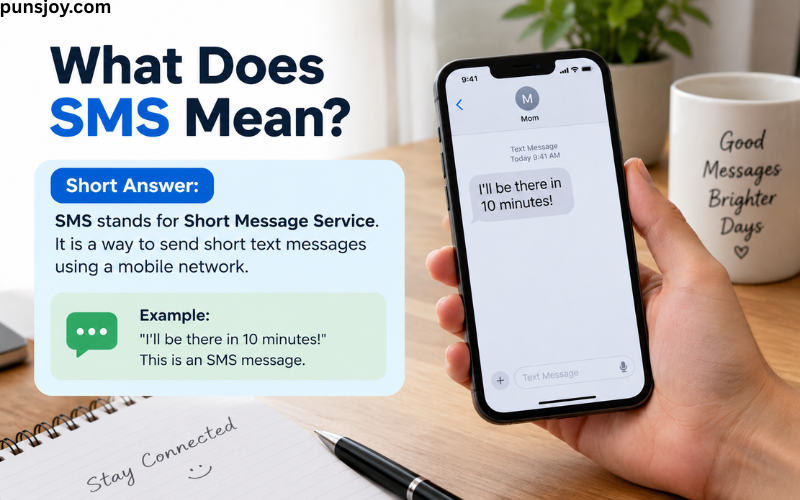
An SMS message is a short text message sent through an SMS-supported mobile network.
It can contain ordinary text, numbers, punctuation, and certain supported characters. Traditional SMS was not originally designed for photographs, videos, or large files. Those types of content are normally handled through other messaging technologies, such as MMS or internet-based messaging.
Some simple examples of SMS messages include:
“Call me when you get home.”
“Your appointment is tomorrow at 10 AM.”
“Your verification code is 482913.”
“Your package has been shipped.”
“Happy birthday!”
These are all examples of information that can be communicated through text messaging.
SMS is particularly useful when the message needs to reach someone quickly without requiring both people to use the same messaging application.
How Many Characters Can an SMS Contain?
A traditional SMS can contain up to 160 characters when it uses the standard GSM-7 character set.
However, the character limit can change when special characters or other writing systems are used. Messages using Unicode, such as many emojis and non-Latin characters, generally have a smaller character capacity per SMS segment.
When a message is longer than the available limit, modern phones can split it into multiple SMS segments. The recipient may see the parts as one continuous message, but the carrier may technically process them as separate message segments.
For example, a long message may be divided into several parts before reaching the recipient.
This is why sending a very long text can sometimes count as multiple messages for billing purposes, depending on the mobile plan.
Does SMS Require Internet?
Traditional SMS does not require an internet connection.
This is one of the biggest differences between SMS and many internet messaging apps.
SMS generally uses the cellular network. If my phone has a cellular signal but no mobile data connection, I may still be able to send and receive SMS messages.
For example, imagine I am somewhere without Wi-Fi and my mobile data is turned off. If I still have cellular service, traditional SMS may continue to work.
However, modern phones can use several different messaging technologies. A message that appears inside the phone’s messaging app does not necessarily mean it was sent using SMS. It could be sent using RCS, MMS, iMessage, or another service.
What Is the Difference Between SMS and MMS?
SMS and MMS are both mobile messaging technologies, but they are designed for different types of messages.
SMS stands for Short Message Service and is primarily designed for text.
MMS stands for Multimedia Messaging Service and supports multimedia content such as pictures, videos, audio, and longer messages.
For example, if I send:
“Where are you?”
that may be sent as SMS.
If I send a photograph with a caption, the message may use MMS or another messaging technology, depending on the phones and networks involved.
MMS generally has different size and carrier limitations than SMS. The exact limits can vary between mobile networks.
| Feature | SMS | MMS |
| Full form | Short Message Service | Multimedia Messaging Service |
| Main purpose | Text messages | Multimedia messages |
| Pictures | Not traditionally supported | Supported |
| Videos | Not traditionally supported | Supported |
| Audio | Not traditionally supported | Supported |
| Internet required | No for traditional SMS | Depends on carrier and setup |
| Common use | Short text messages | Pictures and multimedia |
Today, smartphones can automatically choose the appropriate messaging method, so I may not always notice whether a message is technically being sent through SMS or MMS.
What Is the Difference Between SMS and Text Messaging?
In everyday use, SMS and text messaging often mean the same thing.
If someone says, “Send me a text,” they usually mean they want a message sent to their phone. That message could be delivered through SMS, RCS, iMessage, MMS, or another messaging system.
Technically, SMS is a specific messaging standard, while “text messaging” is a broader everyday term.
For example, I might call a message a text even when it is actually being delivered through RCS.
So, if you see the word SMS in your phone settings, it usually refers specifically to the traditional cellular text-message service.
What Is SMS Used For?
SMS has many uses beyond personal conversations.
Businesses, banks, websites, schools, medical offices, delivery companies, and other organizations use SMS to send short and important notifications.
Some common uses include:
Verification codes: A website may send a temporary code to confirm a phone number or login attempt.
Appointment reminders: A doctor, dentist, salon, or other business may send a reminder before an appointment.
Delivery updates: A shipping company may send updates about a package.
Bank notifications: Banks may send alerts about transactions, account activity, or security events.
Travel notifications: Airlines and other travel companies can send schedule updates or reminders.
Personal communication: People continue to use SMS for quick conversations.
Emergency alerts: Some public warning systems can use cellular messaging technology to reach phones in a particular area.
SMS works well for these purposes because a person does not necessarily need to install a special messaging app.
What Does SMS Mean on My Phone?
If you see “SMS” in your phone’s messaging settings, it usually refers to traditional text messaging through your mobile carrier.
For example, your phone may have options related to:
- Send as SMS
- SMS delivery reports
- SMS center
- SMS settings
- SMS messages
- SMS fallback
The exact wording depends on the phone manufacturer, operating system, carrier, and messaging application.
One important setting is sometimes called Send as SMS. This can allow a phone to send a traditional SMS when another messaging method is unavailable.
For example, if a conversation normally uses an internet-based messaging service but the connection fails, the phone may offer or automatically use SMS, depending on the settings.
What Does SMS Mean in a Message Status?
You may see terms such as “Sent,” “Delivered,” or “Read” when sending a message.
These terms do not always mean exactly the same thing.
Sent generally means the message has left your phone or has been accepted by the messaging system.
Delivered generally means the message has reached the recipient’s device or network according to the available delivery information.
Read usually means the recipient has opened or viewed the message, but read receipts depend on the messaging technology and settings.
Traditional SMS does not provide the same type of universal read-receipt system found in some modern messaging services. A phone may provide delivery reports, but the available information depends on the carrier and device.
What Does SMS Mean in Business Communication?
SMS is widely used by businesses because it is a direct way to contact customers.
A company may use SMS to confirm an order, remind a customer about an appointment, provide a delivery update, or send a temporary verification code.
For example, after making an appointment online, I might receive a message saying:
“Reminder: Your appointment is scheduled for Tuesday at 2:00 PM.”
This can be more useful than an email in situations where the information is time-sensitive.
Businesses should still use SMS responsibly. Unwanted promotional messages can become annoying, and organizations need to follow applicable communication, privacy, and consent requirements when sending commercial text messages.
What Is an SMS Verification Code?
An SMS verification code is a temporary number or combination of characters sent to a phone number for verification.
For example, when I sign in to a service, it might send a six-digit code to my phone.
The idea is that the person attempting to access the account should have access to the registered phone number.
A typical message might say:
“Your verification code is 739204.”
I should never share a verification code with another person unless I fully understand why it is needed and trust the legitimate service involved.
Scammers sometimes pretend to be banks, websites, delivery companies, or other organizations and ask people to provide SMS verification codes. Giving a code to an attacker can allow them to complete an account login or other action.
SMS-based verification can be useful, but it is not considered the strongest form of account security. Where available, stronger options such as authenticator apps or security keys can provide better protection.
Is SMS Secure?
SMS is useful, but I would not treat it as a completely secure communication method.
Traditional SMS was designed mainly for reliable mobile communication, not for modern end-to-end encrypted private conversations.
Messages can pass through mobile carrier systems, and SMS does not normally provide the same end-to-end encryption associated with some modern messaging applications.
There are also security risks involving phone numbers. For example, attackers may attempt SIM swapping, where they fraudulently convince a mobile carrier to move a victim’s phone number to another SIM or device.
That can create problems when SMS is used for account verification.
For ordinary reminders and simple communication, SMS remains useful. However, I would avoid sending highly sensitive information through ordinary SMS when a more secure communication option is available.
What Is SMS Spam?
SMS spam refers to unwanted or unsolicited text messages.
Examples include fake delivery notices, fraudulent account alerts, unwanted advertising, and messages designed to make the recipient click a suspicious link.
A common scam might claim that a package could not be delivered and ask the recipient to click a link to “fix” the delivery.
I recommend being cautious whenever an unexpected SMS asks me to:
- Click an unfamiliar link
- Provide a password
- Give a verification code
- Send money
- Confirm sensitive personal information
- Download an unexpected application
If a message claims to come from a bank, delivery company, government agency, or another organization, I prefer to contact that organization using its official website or known phone number instead of using contact details included in a suspicious text.
What Does SMS Mean Compared With RCS?
RCS stands for Rich Communication Services. It is a newer messaging standard designed to provide features that traditional SMS does not offer.
Depending on the device, carrier, and service configuration, RCS can support features such as:
- Typing indicators
- Read receipts
- Higher-quality media sharing
- Group conversations
- Larger messages
- Better messaging features
SMS is much older and more limited.
The important difference is that SMS is a basic cellular text messaging service, while RCS provides a richer messaging experience.
Modern smartphones may automatically use RCS when available and fall back to SMS when it is not. This can make the technical difference less obvious to the person using the phone.
SMS vs. iMessage
SMS and iMessage are also different technologies.
SMS is a cellular messaging standard that can generally communicate across different mobile phone platforms.
iMessage is Apple’s messaging service designed for communication between supported Apple devices. It uses an internet connection rather than traditional SMS for its normal operation.
On an iPhone, the Messages app can handle different types of messages. Depending on the recipient and settings, a message may be sent through iMessage, SMS, MMS, or other supported systems.
This means that simply using the Messages app does not automatically mean that every message is an SMS.
Can I Send SMS Without Wi-Fi?
Yes. Traditional SMS does not depend on Wi-Fi.
If I have cellular service, I can generally send and receive SMS even when Wi-Fi is unavailable.
However, there are exceptions based on carrier coverage, phone settings, roaming conditions, account status, and network availability.
If I have no cellular signal and no internet connection, I may not be able to send a traditional SMS message.
This is different from apps such as WhatsApp or Messenger, which normally need an internet connection to send messages.
Why Is SMS Still Used Today?
SMS may seem old compared with modern messaging apps, but it continues to have practical advantages.
First, almost every mobile phone can support traditional SMS. The recipient does not necessarily need to have the same messaging app as the sender.
Second, SMS can work without Wi-Fi or mobile data.
Third, businesses can reach customers through a phone number without requiring them to create an account in a separate application.
Fourth, SMS is useful for short information that does not require images, large files, or advanced messaging features.
For these reasons, I still see SMS used for verification codes, reminders, alerts, and simple communication even though newer messaging systems offer more features.
Does Sending SMS Cost Money?
The cost of SMS depends on the mobile carrier and the user’s plan.
Some mobile plans include unlimited domestic text messages. Others may charge per message or have different rules for international texting.
Long messages can sometimes be divided into multiple SMS segments, which may matter on plans that charge per message.
International SMS can also have different charges.
Because pricing varies widely, I recommend checking the current SMS terms of the specific mobile carrier rather than assuming that every text message is free.
What Happens If My Phone Is Turned Off?
If someone sends me an SMS while my phone is turned off, the mobile carrier may temporarily hold the message and attempt to deliver it when my phone reconnects to the network.
The exact behavior and storage period depend on the carrier.
This is one reason SMS can be useful for basic communication. The recipient does not necessarily need to have their phone powered on at the exact moment the sender sends the message.
Once the phone reconnects and the message is successfully delivered, it can appear in the phone’s messaging application.
Can SMS Be Sent to Another Country?
Yes, SMS can be sent internationally when the mobile carriers and plans support international messaging.
However, international texting may have additional costs or restrictions.
For example, sending an SMS from one country to a phone number registered in another country can be treated differently from domestic texting.
Before sending a large number of international messages, I would check the carrier’s international SMS rates and terms.
What Does SMS Stand For in Other Contexts?
Although Short Message Service is by far the most common meaning when talking about mobile phones, abbreviations can have different meanings in other industries.
If I see “SMS” in a phone, messaging app, mobile plan, or telecommunications discussion, it almost certainly refers to Short Message Service.
The surrounding context is important if the abbreviation appears in a completely different field.
Common SMS Terms You Should Know
Understanding a few common terms makes phone messaging easier.
SMS: Short Message Service, the traditional mobile text messaging system.
MMS: Multimedia Messaging Service, used for multimedia messages such as pictures and videos.
RCS: Rich Communication Services, a newer messaging standard with more advanced features.
Delivery report: Information indicating whether a message was successfully delivered according to the available network information.
Read receipt: An indication that a recipient has opened or read a message, when supported.
SMS gateway: A system that allows software or business applications to send or receive SMS messages through telecommunications networks.
Short code: A short telephone number commonly used by businesses and services for automated messaging.
OTP: One-time password or one-time passcode, often delivered through SMS for verification.
These terms can appear in phone settings, business software, account-security messages, and mobile-service documentation.
FAQs
What does SMS mean?
SMS means Short Message Service. It is a mobile communication system used to send short text messages through cellular networks.
What is the full form of SMS?
The full form of SMS is Short Message Service.
Does SMS need the internet?
Traditional SMS does not require Wi-Fi or mobile data. It normally uses a cellular network. However, modern messaging apps may use internet-based systems instead of traditional SMS.
Is SMS the same as a text message?
In everyday conversation, the terms are often used interchangeably. Technically, SMS is one specific type of text messaging technology, while “text message” can refer to several messaging systems.
What is the difference between SMS and MMS?
SMS is primarily designed for text messages, while MMS was created to support multimedia such as pictures, videos, and audio.
What is SMS verification?
SMS verification involves sending a temporary code to a phone number to confirm access to that number or help verify an account action.
Is SMS secure?
SMS is useful but does not normally provide the same end-to-end encryption found in some modern messaging services. I would avoid using ordinary SMS for highly sensitive information when a more secure option is available.
Can I send SMS without Wi-Fi?
Yes. Traditional SMS can work without Wi-Fi as long as your phone has an appropriate cellular connection and your carrier supports SMS.
Why does my phone say SMS instead of chat?
Your phone may be using traditional SMS because the recipient’s device, carrier, messaging service, or current connection does not support the richer messaging method being used.
Why did my long text become multiple messages?
Traditional SMS has character limits. A long message may be divided into multiple SMS segments so it can be delivered to the recipient.
Can I send SMS internationally?
Yes, international SMS is possible when supported by the carriers involved. International messaging may have different charges and restrictions.
What is SMS spam?
SMS spam consists of unwanted text messages. Some spam is simply advertising, while other messages may be attempts to steal information, money, account credentials, or verification codes.
Related Post: What Does RQ Mean in Text:
Conclusion
SMS means Short Message Service, and it is one of the basic technologies behind mobile text messaging. It was designed for short messages and continues to play an important role in everyday communication.
When I send a traditional text without relying on an internet messaging application, SMS may be the technology carrying that message. It is also widely used for verification codes, appointment reminders, delivery notifications, banking alerts, and business communication.
Modern technologies such as RCS and internet messaging apps offer features that traditional SMS does not, including richer media sharing, read receipts, typing indicators, and other advanced tools. Even so, SMS remains useful because of its simplicity, broad compatibility, and ability to work through cellular networks without requiring Wi-Fi.
The next time you see “SMS” in your phone settings, a message status, or a mobile-service description, you can understand exactly what it means: Short Message Service, the traditional system used to send short text messages over mobile networks.

Emily here. I write about puns, slang, and the quirky side of language because words are funnier than people give them credit for. Four years in, and I still laugh at my own jokes. Someone has to.
