

In 2025, ATP went from a biology textbook term to one of the most searched texting abbreviations on the internet and it happened almost overnight. One viral TikTok, a few thousand comments, and suddenly everyone from teenagers to their confused parents was seeing it everywhere.
Group chats, Instagram captions, Snapchat streaks, late night WhatsApp messages. ATP slang meaning had people confused on every platform at once. By the time you finish reading this, you will know exactly what it means, how to use it, how to respond to it, and why this one little acronym somehow captured an emotion that full sentences have always struggled to explain.
What Does ATP Mean in Text?
If you’ve seen ATP pop up in a message and done a double take, you’re not the first person and definitely won’t be the last.
ATP stands for “at this point.” In texting, people drop it when they’ve reached a conclusion, hit a wall, or simply run out of patience with a situation. The ATP meaning in text isn’t tied to one emotion either. It can sound frustrated, resigned, sarcastic, or even funny depending on what follows it.
Example 1: “ATP I’m just going to do it myself.” That’s frustration talking.
Example 2: “ATP let him be late, I’m not waiting anymore.” That’s someone who has genuinely moved on.
Example 3: “ATP this is just my life now lol.” Same three letters, completely different energy.
What makes this ATP slang meaning work so well is how naturally it fits real conversation. You read it and you immediately know where that person’s head is at. No explanation needed between friends. That kind of shorthand doesn’t happen by accident, it earns its place.
All the Meanings of ATP
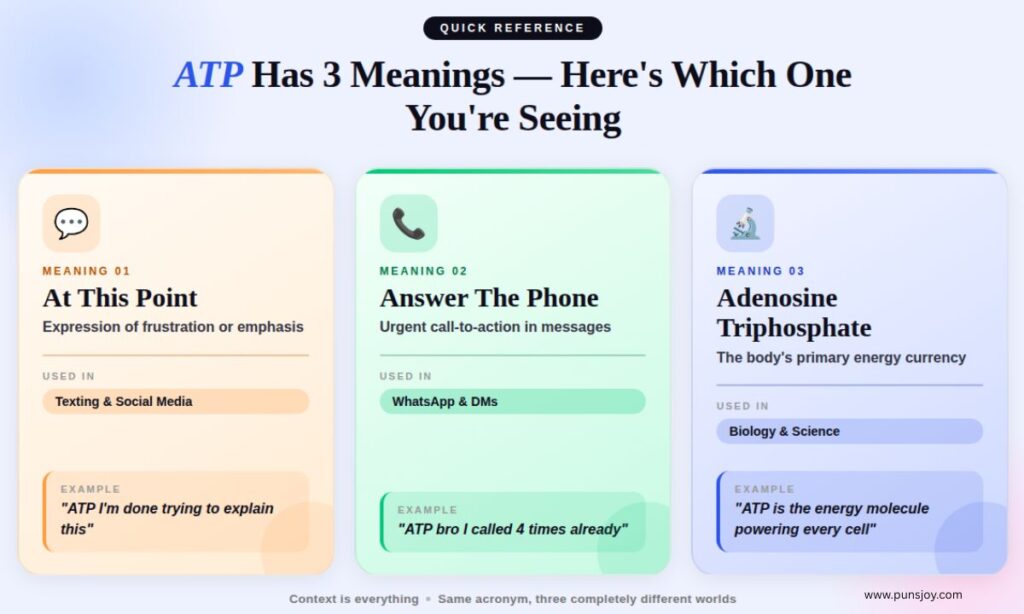
ATP isn’t a one meaning acronym. Where you see it changes everything.
At This Point
This is the ATP meaning you’ll run into everywhere. TikTok comments, Instagram captions, late night texts, Discord servers — it’s always “at this point.” It signals that someone has mentally checked out of a situation after dealing with it long enough. The phrase carries a whole backstory in three letters.
Example 1: “ATP she can keep the hoodie.”
Example 2: “ATP I’m just going to fail this class and move on.”
Answer The Phone
This one’s older and still shows up, mostly in WhatsApp chats and direct messages. Someone’s been calling, you’re not picking up, and they’ve officially lost patience.
Example 1: “Bro ATP I’ve called you four times.”
Context separates the two. “At this point” comes with a conclusion or complaint attached. “Answer the phone” usually arrives alone, dripping with frustration.
ATP in Biology and Medical Contexts
In science, ATP means Adenosine Triphosphate — the molecule responsible for energy in your cells. If you found this article through a biology search, that topic lives elsewhere. This one’s strictly about slang.
ATP in Business and Sales
In supply chain and corporate settings, ATP stands for Available To Promise or Acceptance Test Procedure. Nothing to do with texting. If you spotted it in a work email, that’s the version you’re dealing with.
ATP in Gaming and Discord
Gaming lobbies and Discord servers use ATP exactly like general slang. “At this point” fits naturally when someone’s mid-game and completely done with how things are going.
Where Did ATP Slang Come From?

ATP didn’t explode overnight. It built slowly, the way the best slang always does.
The earliest definition of ATP as “at this point” was logged on Urban Dictionary back in July 2010. Someone typed it, added an example and moved on. For the next decade it lived quietly in online forums and gaming chats where abbreviating everything was already second nature. It wasn’t trending. It wasn’t viral. It was just useful.
Then 2020 arrived and changed everything. More people online, longer hours on phones, group chats running nonstop. The phrase “at this point” was coming up constantly because everyone was dealing with situations that refused to resolve themselves. Typing it out in full started feeling slow. ATP was already there waiting.
Example 1: By 2022, TikTok creators were using it in captions without explaining it and nobody in the comments needed them to.
Example 2: “ATP just come over” after three cancelled plans. Two words, zero explanation, perfect delivery.
By 2023 it had gone from niche to normal. That’s the real marker for any slang term, not when it trends for a week but when people start using it without thinking about it. ATP crossed that line and quietly became part of how people actually talk.When did ATP start trending at scale? Somewhere between a TikTok caption and a frustrated group chat message in early 2023 and it never really stopped.
How to Use ATP Correctly in a Sentence
ATP without context is just three letters. ATP with the right sentence behind it hits like a full paragraph.
The trick is simple. ATP belongs at the front of a conclusion, a reaction, or a decision you’ve finally reached after too long. It doesn’t work as a standalone reply and it doesn’t work when the emotion isn’t there. When it’s genuine, nobody questions it. When it’s forced, everyone feels it.
Put it at the start when you’re done waiting.
Example 1: “ATP I’m not even arguing about this anymore.”
Example 2: “ATP just tell me yes or no.”
Example 3: “ATP she’s not coming, let’s just go.”
Example 4: “ATP I’ve accepted that this is how it’s going to be.”
Drop it mid-sentence when the buildup needs to show.
Example 5: “I gave it every chance but ATP I’m out.”
Example 6: “We’ve talked about this three times and ATP nothing’s changed.”
One thing to avoid is using it without anything after it. “ATP.” as a full reply leaves the other person guessing. The sentence that follows ATP in a sentence is where the actual meaning lives. The acronym just tells them you’ve reached the end of your patience. What comes next tells them what you’re doing about it. That’s the difference between using ATP correctly and just throwing it in hoping it fits.
Why “ATP” Hits Different: The Psychology of 3 Letters
Most slang tells you what someone feels. ATP tells you how long they’ve been feeling it.
That one detail is what separates it from everything else. LOL, BRB, TBH — they’re all snapshots of a single moment. ATP carries an entire timeline inside it. When someone types it, they’re not just describing where they are. They’re telling you there was a whole road that got them there.
ATP vs LOL, BRB, TBH
LOL is a reaction. BRB is an action. TBH is a confession. None of them suggest anything happened before the moment you sent them.
ATP does. When someone writes “ATP I’m done,” they’re not reporting a current feeling. They’re reporting the conclusion of a series of events nobody asked them to explain. That’s why the psychology of texting slang around ATP is unlike anything else in Gen Z communication. Three letters doing the work of a backstory.
Example 1: “TBH I don’t like him” is a preference. “ATP I don’t like him” is a verdict reached after too many second chances.
Example 2: “LOL this is a mess” is a reaction. “ATP this is a mess” means it’s been falling apart for a while and you’ve stopped pretending it isn’t.
Why Gen Z Gravitated Toward It
Gen Z communication style has never been about saying more. It’s about saying the right thing with the least possible words. ATP fits that because it carries tone, timing, and emotional weight in one shot.
The phrase “at this point” already existed in everyday speech long before the acronym did. Gen Z didn’t invent the feeling. They just found a faster way to send it. And because ATP slang popularity grew through group chats and comment sections rather than one single viral post, it never felt like a trend people were performing. It felt like something they were already thinking. That same instinct for efficient, loaded language is why terms like slay took hold in the same generation and the same group chats.
Example 1: “ATP just leave it” dropped into a group chat after a long argument needs zero context. Everyone already knows what happened before that message.
Example 2: A TikTok caption reading “ATP I give up” under a relatable fail video got thousands of comments using the exact same three letters. No explanation. No translation needed.
Emoji Amplification

This is the part most people miss. The same three letters carry completely different emotional weight depending on what follows them.
“ATP 😭” is exhaustion. Something went wrong and the person sending it is not okay about it.
“ATP 💅” is unbothered. They’ve moved on and they feel good about that decision.
“ATP 🔥” is energy. Something finally clicked and they’re ready to go.
Why is ATP so popular? Partly because of this. The acronym doesn’t lock you into one emotion. It works across frustration, humor, confidence, and acceptance without changing a single letter. That kind of range is rare in expressive texting abbreviations and Gen Z recognized it early.
How to Respond When Someone Texts You ATP
Before you type anything back, read what came after those three letters. That’s the actual message.
ATP is the opener. The sentence behind it tells you what kind of reply the person actually needs. Getting that wrong is worse than not replying at all.
When ATP signals frustration:
Example 1: “ATP I can’t do this anymore.” They don’t want solutions. They want someone to acknowledge that things are genuinely hard right now.
Good reply: “That sounds exhausting, I’m sorry.” Bad reply: “Have you tried talking to them about it?”
When ATP signals they’ve already moved on:
Example 2: “ATP I don’t even care.” They’ve closed the door. Don’t drag them back through it.
Good reply: “Honestly fair. New topic?” Bad reply: “Are you sure? You seemed really upset before.”
Sometimes the right response to an ATP message is simply an invitation to move on, which is exactly where knowing HMU meaning in text comes in handy.
When ATP is clearly being used for humor:
Example 3: “ATP I’m just going to marry my couch.” They’re being dramatic on purpose. The worst thing you can do is take it seriously.
Good reply: “I’ll be at the wedding.” Bad reply: “Aww are you okay?”
When ATP means Answer The Phone:
Example 4: “ATP” after three missed calls. This one needs no reading between the lines. Call them back or explain why you couldn’t pick up.
Replying to ATP text messages correctly comes down to matching the energy of what was sent. The people who get it right aren’t better at texting. They’re just paying attention to what the other person actually said instead of what they assumed.
ATP on Every Platform: TikTok, Snapchat, Instagram, WhatsApp & More

ATP doesn’t behave the same way everywhere. Same three letters, but the energy shifts depending on where you’re typing them.
TikTok
TikTok is where ATP meaning slang found its biggest audience. It shows up in captions as an emotional punchline and in comment sections as a shared reaction. The tone here leans dramatic, relatable, and often funny. Nobody’s being completely serious on TikTok and ATP fits right in.
Example 1: Caption reads “ATP I’m changing my major 😭” and the comments fill up with people writing the exact same thing. No explanation needed. Everyone already knows the feeling.
Example 2: “ATP just let the character die” under a gaming fail compilation. Pure frustrated humor.
POV does the same thing on TikTok, same captions, same energy, different meaning.
Snapchat
Snapchat is more personal than TikTok and the ATP meaning on Snapchat shows it. It shows up in direct messages and story captions where the conversation is between people who actually know each other. The tone here is less performative and more genuinely venting.
Example 1: “ATP I need a vacation” as a story caption after a rough week.
Example 2: “ATP just tell me what you want to do” in a back and forth chat that’s been going in circles for twenty minutes.
ATP on Instagram has two modes. Captions use it for the self-aware growth angle the platform runs on. Comments use it for reaction and solidarity. The ATP meaning on Instagram stays the same but the delivery changes based on who’s watching.
Example 1: Caption: “ATP I’m focused on myself.” Short, clean, says everything about where someone is mentally.
Example 2: Comment under a relatable meme: “ATP this is literally me every Monday.”
What does ATP mean in WhatsApp? Same meaning, but the setting changes how it lands. WhatsApp runs on closer circles — friends, family groups, work chats — so ATP here carries more genuine frustration than performance. Nobody’s putting on a show for an audience.
Example 1: “ATP someone else plan the dinner, I give up.” Dropped into a family group chat after three days of nobody deciding anything.
Example 2: “ATP just call me, this is taking too long to explain over text.”
Twitter / X
Twitter runs on opinions and reactions and ATP meaning in chat here adds emotional time-context to a take. You’re not just stating an opinion. You’re announcing a conclusion you reached after watching something play out too many times.
Example 1: “ATP brands just need to stop trying to be funny online.” That’s not a fresh reaction. That’s someone who has watched this happen one too many times.
Example 2: “ATP I just mute and move on” in response to a chaotic thread. Done, decided, finished.
Gaming and Discord
Gaming communities and Discord servers took to ATP naturally because frustration is basically the default emotion in both spaces. On Twitch, streamers drop it mid-run. In multiplayer chats, it signals someone’s reached their limit with a game, a teammate, or a losing streak. It doesn’t need explaining because everyone in those servers has been exactly there.
Example 1: “ATP uninstall the game” after the fourth loss in a row.
Example 2: In a Discord vent channel: “ATP I’m just watching others play, I’m done.”
ATP vs. Similar Slang: IDC, TBH, NGL, FR
People mix these up constantly. They’re all casual, they all show up in the same kinds of conversations, but they’re not swappable and using the wrong one changes what you’re actually saying.
The key difference with ATP is that it implies something came before it. It’s a conclusion, not just a statement. Every other acronym on this list is a snapshot. ATP is an ending.
ATP vs IDC
IDC means “I don’t care” and it’s blunt, direct, and final. ATP is softer even when it’s saying the same thing. “IDC anymore” sounds harsh. “ATP I don’t care anymore” sounds like someone who got there after a lot of patience. The slang comparison here is about tone as much as meaning.
Example 1: “IDC what he thinks” is dismissive from the start. Example 2: “ATP I don’t care what he thinks” tells you there was a time they cared very much.
ATP vs TBH
TBH introduces an honest opinion. It’s a confession opener. ATP introduces a conclusion. The difference between ATP and TBH is the difference between sharing a thought and announcing a verdict.
Example 1: “TBH I never liked that plan.” Present honesty. Example 2: “ATP that plan was never going to work.” Conclusion after watching it fail.
ATP vs NGL
NGL carries a confessional quality. You’re admitting something you maybe shouldn’t. ATP doesn’t confess anything. It declares.
Example 1: “NGL that movie was actually good.” Reluctant admission. Example 2: “ATP just watch the movie, stop asking.” Final decision energy.
ATP vs FR
FR means “for real” and it confirms or emphasizes. ATP closes. You’d drop FR to back up a point mid-conversation. ATP shows up when the conversation is already over in your head.
Example 1: “That was unfair FR.” Emphasizing something fresh. Example 2: “ATP I’m done arguing about it.” Nothing left to emphasize.
When ATP Means “Answer The Phone” — How to Tell the Difference
ATP has two lives and they have nothing to do with each other.
Most of the time it’s “at this point.” But when someone’s been calling and you haven’t picked up, ATP flips and becomes “answer the phone.” Both versions look identical in a message. Same three letters, completely different urgency level.
Here’s how to tell the two apart every time.
Clue 1: What came right before it
If there were missed calls, an unanswered FaceTime, or a message saying “I’ve been trying to reach you,” the ATP that follows almost certainly means answer the phone.
Example 1: Three missed calls. Then: “ATP.” That’s not a conclusion about life. That’s an instruction.
Clue 2: What comes after it
“At this point” ATP always has something after it. A feeling, a decision, a reaction. “Answer the phone” ATP usually stands alone or comes with a direct reference to the missed calls.
Example 2: “ATP I’m not waiting anymore” is “at this point.” Example 3: “ATP bro I’ve called you twice” is “answer the phone.”
Clue 3: The platform and context
The atp answer the phone meaning shows up most in WhatsApp and direct messages between people who actually call each other. On TikTok comment sections or Twitter replies, it’s almost always “at this point” because nobody’s expecting a phone call from a stranger under a viral post.
Example 4: ATP in a TikTok comment = at this point, every time. Example 5: ATP after three missed calls on WhatsApp = answer the phone, every time.
The atp two meanings are easy to separate once you know what signals to read. Missed calls plus ATP equals answer the phone. Emotional buildup plus ATP equals at this point.
Is ATP Appropriate at Work, School, or With Adults?
Context is everything with this one.
ATP works beautifully in the right crowd. Drop it in the wrong room and the whole vibe shifts. Knowing when to use it and when to leave it out is honestly the difference between sounding natural and sounding like you forgot where you were.
In a professional context, ATP doesn’t really belong. Imagine sending your manager:
- “ATP just approve the budget already.”
- “ATP this meeting could’ve been an email.”
Funny between friends. Career limiting everywhere else. Slang in formal situations reads as careless even when you don’t mean it that way. Save it for people who already text like you do.
School sits somewhere in the middle. With classmates it flows fine. With a teacher or in a written assignment, skip it entirely. ATP with adults who didn’t grow up in group chat culture often lands as confusing rather than casual. They might smile through it but they’re probably Googling it the second you walk away.
The real question isn’t whether ATP is appropriate. It’s whether the person reading it will get it immediately. If there’s even a small chance they won’t, just write it out. “At this point” takes two extra seconds and zero explanation.
Common Mistakes People Make With ATP
People get this one wrong more than you’d think.
The most common ATP mistake is sending it completely alone. Just “ATP.” as a reply with nothing after it. The whole phrase exists to deliver a conclusion. Strip that conclusion away and you’ve sent three letters that mean absolutely nothing to the person reading them. That’s not vague. That’s just incomplete.
Here’s what that actually looks like:
- Someone vents about their day and you reply “ATP.” They’re left waiting for the rest of a sentence that never came. The fix is simple: “ATP just take the day off, seriously.” Now it lands.
- Using ATP mid-conversation to agree with something is another misuse people don’t notice they’re doing. It signals an ending, not a reaction. Dropping it as a casual “yeah same” replacement makes the message feel off even if the reader can’t explain why.
The other ATP misunderstanding worth knowing is treating it like “honestly” or “literally.” Those add weight to something you’re currently feeling. ATP tells someone you’ve been sitting with something long enough to reach the other side of it. They’re doing completely different jobs in a sentence.
One last thing. Platform and audience matter more than people give them credit for. A work Slack, a message to a relative, a formal email thread — these aren’t the places for it. Not because ATP is inappropriate by nature but because slang only works when both people already speak the same language.
ATP in 2026: How the Slang Has Evolved
ATP didn’t peak and fade. It settled in.
A lot of slang burns bright for a season and then sounds dated six months later. ATP in 2026 doesn’t feel like that. It embedded itself into everyday texting the way “literally” did before it. People aren’t using it because it’s trendy anymore. They’re using it because it just fits.
The slang evolution here is subtle but real:
- In 2022 and 2023, ATP was still being explained in comment sections. People would use it and immediately clarify “at this point” for anyone who asked.
- By 2025 that stopped almost entirely. Nobody explains it anymore. That’s how you know a word has actually arrived.
- In 2026, Gen Alpha is picking it up the same way older Gen Z did. No instruction needed. Just absorbed through group chats and video comments.
Is ATP still used? Every single day, across every platform that runs on casual conversation. Current slang trends in 2026 show it holding steady while newer phrases cycle in and out around it. It’s not the word anyone’s excited to discover right now. It’s just part of how people talk, which is a different kind of staying power entirely and honestly the harder one to earn. Newer words like brat cycle through the same spaces and still haven’t stuck the same way.
ATP Across Generations: What Parents & Teachers Need to Know
If your kid typed ATP and you quietly opened a new tab to figure out what just happened, this part’s for you.
ATP slang explained simply for parents is this: it almost always means “at this point.” Your teenager isn’t being secretive. They’re just expressing frustration or a conclusion they’ve reached about something. Think of it as the texting version of “I’ve had enough of this situation.”
Here’s what it looks like in real conversations:
- Your child texts a friend “ATP I’m just going to do the project alone.” That’s not a crisis. That’s a group project falling apart and one person deciding to stop waiting.
- A student writes “ATP this homework makes no sense” in a class group chat. Frustration, not disrespect.
For teachers, ATP in a student’s message isn’t alarming. It’s just how this generation processes being overwhelmed out loud.
What does ATP mean to parents beyond the translation? It usually means your kid has been sitting with something long enough to make a decision about it. Knowing that before you respond changes the whole direction of the conversation. You’re not correcting a word. You’re walking into a moment that already has some history behind it.
Quick-Reference Cheat Sheet: ATP at a Glance
Sometimes you just need the short version.
This ATP quick reference covers everything in one place so you’re never guessing mid-conversation again.
- Primary meaning: “At this point.” Used when someone has reached a conclusion after dealing with something long enough.
- Secondary meaning: “Answer the phone.” Shows up after missed calls, usually on WhatsApp or direct messages. Stands alone without any sentence after it.
- How to tell the difference: “At this point” always has a conclusion following it. “Answer the phone” arrives alone or right after a mention of missed calls.
- Where it lives: TikTok captions, Instagram comments, Snapchat chats, WhatsApp groups, Twitter replies and Discord servers.
- When to use it: With friends, in casual group chats, on social media. Anywhere the conversation is already relaxed.
- When to skip it: Work emails, messages to teachers, formal situations, or anyone who might need to Google it after reading it.
- How to respond: Read what comes after ATP first. Match that energy. Frustration gets acknowledgment. Humor gets humor. A decision gets respected, not questioned.
Everything you needed to know. No scrolling back required.
Frequently Asked Questions
What does ATP mean in text?
ATP stands for “at this point” in texting. It shows up when someone has reached a conclusion or run out of patience with a situation. Three letters doing the work of an entire backstory.
Does ATP always mean “at this point”?
Almost always, yes. The only exception is when someone’s been calling and you haven’t picked up. In that case ATP means “answer the phone” and it usually arrives alone with nothing after it.
What does ATP mean on Snapchat specifically?
Same meaning as everywhere else — “at this point.” Snapchat just makes it feel more personal because the conversations are between people who actually know each other rather than strangers in a comment section.
Is ATP rude to use?
Not by itself. The tone depends entirely on what follows it. “ATP I’m proud of you” is warm. “ATP I’m done with this” is firm. The word isn’t the mood. The sentence behind it is.
Can adults use ATP or is it just for Gen Z?
Anyone can use it as long as the person reading it will understand it immediately. Age isn’t the barrier. Knowing your audience is.
Why do people use ATP instead of just saying “at this point”?
Same reason anyone abbreviates anything. It’s faster, it fits the rhythm of how people actually text, and once you’ve seen it enough times it just feels natural to type.
What’s the difference between ATP and NGL?
NGL is a confession. You’re admitting something you maybe wouldn’t say out loud. ATP is a declaration. You’ve reached a decision and you’re announcing it. Different jobs entirely.
Is ATP still relevant in 2026?
Completely. It’s moved past the trend phase and into everyday vocabulary. People aren’t using it to sound current anymore. They’re using it because it fits, which is the longer lasting kind of relevant.
Conclusion
Nobody sat down and decided ATP was going to matter. There was no campaign, no announcement, no moment where youth communication trends pointed at three letters and said this one. It spread the way all honest language spreads — because it described something people were already feeling and couldn’t say faster any other way. Informal language patterns in digital spaces move like that. The ones that survive aren’t the ones that get pushed. They’re the ones that get used at 1am in a group chat when someone finally stops pretending a situation is fine.
What makes ATP worth understanding isn’t really about staying current with messaging shorthand or knowing what Gen Z is typing. It’s simpler than that. Language that lasts always earns its place by saying something true. ATP says you’ve been through something and you’ve come out the other side with a decision. That’s a very human thing to need to communicate. The fact that it happens in three letters now instead of three sentences just means the feeling got faster. The feeling itself was never new.

Emily here. I write about puns, slang, and the quirky side of language because words are funnier than people give them credit for. Four years in, and I still laugh at my own jokes. Someone has to.
